Types of Generative AI Models
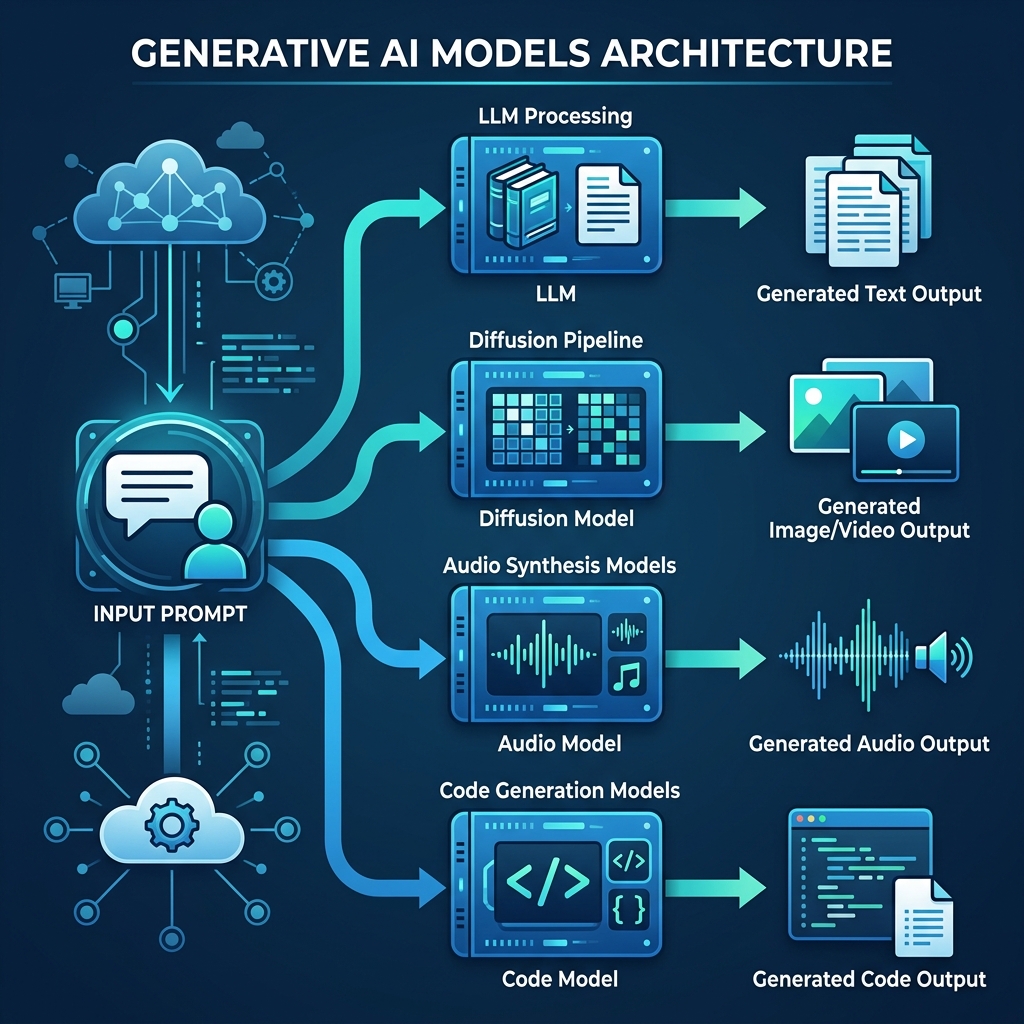
Generative AI isn't just about text chatbots. The technology has expanded into almost every creative medium, allowing computers to generate images, audio, video, and even functioning software code.
1. Text Generators (LLMs) ✍️
Large Language Models (LLMs) like ChatGPT, Claude, and Gemini are the most famous type of Generative AI. They are trained on massive amounts of text data from the internet.
What they do:
Write essays, summarize long documents, draft emails, translate languages, and answer complex questions.
2. Image & Video Generators 🎨
Image generation models (like Midjourney, DALL-E 3, and Stable Diffusion) use a technique often called "Diffusion". They start with random static noise and slowly refine it into a crystal-clear image based on your text prompt.
What they do:
Create original artwork, generate photorealistic stock photos, design logos, and even generate short video clips (like OpenAI's Sora).
💡 Diffusion Models Simply Explained
Imagine looking at a cloud in the sky that looks vaguely like a dog. A Diffusion model essentially stares at a "cloud" of random pixels and keeps tweaking them until they perfectly match the prompt you gave it (e.g., "A golden retriever in space").
3. Audio & Voice Generators 🎵
Audio Generative AI can synthesize completely new sounds. This includes text-to-speech models that sound entirely human, complete with breaths, pacing, and emotion.
What they do:
Generate original background music for videos, clone a person's voice (with permission) for audiobooks, or create sound effects on demand.
4. Code Generators 💻
While code is technically text, Code Generators (like GitHub Copilot and Cursor) are specially trained on millions of repositories of source code. They understand the syntax of programming languages.
What they do:
Autocomplete lines of code as a programmer types, find and fix bugs, and even build entire simple applications from a single text prompt.
📌 Deep Dive: Understanding This Concept
As Generative AI systems become more complex, mastering the underlying principles of This Concept is essential for developers. Proper implementation in this area ensures that your AI applications remain scalable, performant, and secure when deployed to production environments.
Quick Knowledge Check
Test what you just learned
Question 1 of 2
Which of the following models is specifically designed to generate new images from text descriptions?
Question 2 of 2
What is the primary function of a Code Generator like GitHub Copilot?
Loading results...