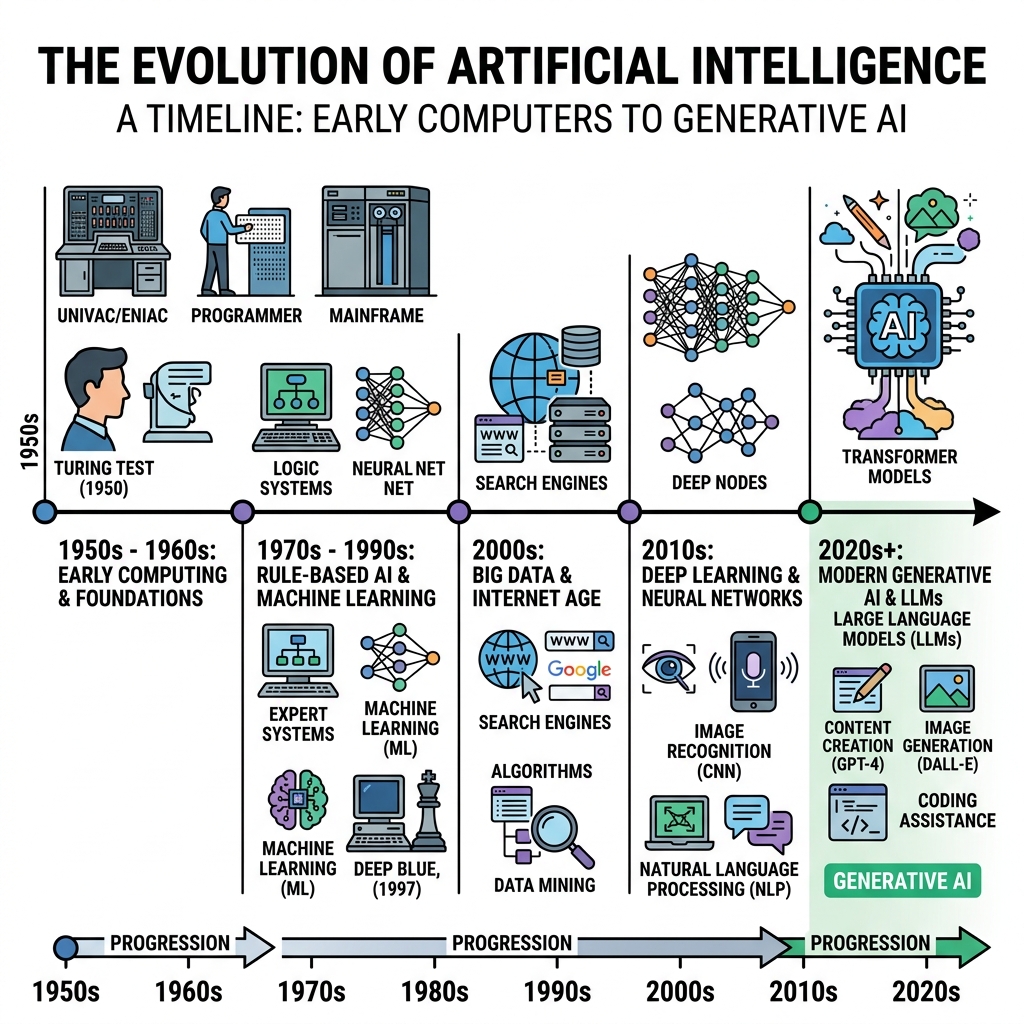
It feels like Generative AI magically appeared overnight, doesn't it? One day we had regular computers, and the next day they were writing poems and painting pictures.
But the truth is, scientists have been slowly building this technology for over 70 years! Let's take a quick, jargon-free walk through history to see exactly how we got here.
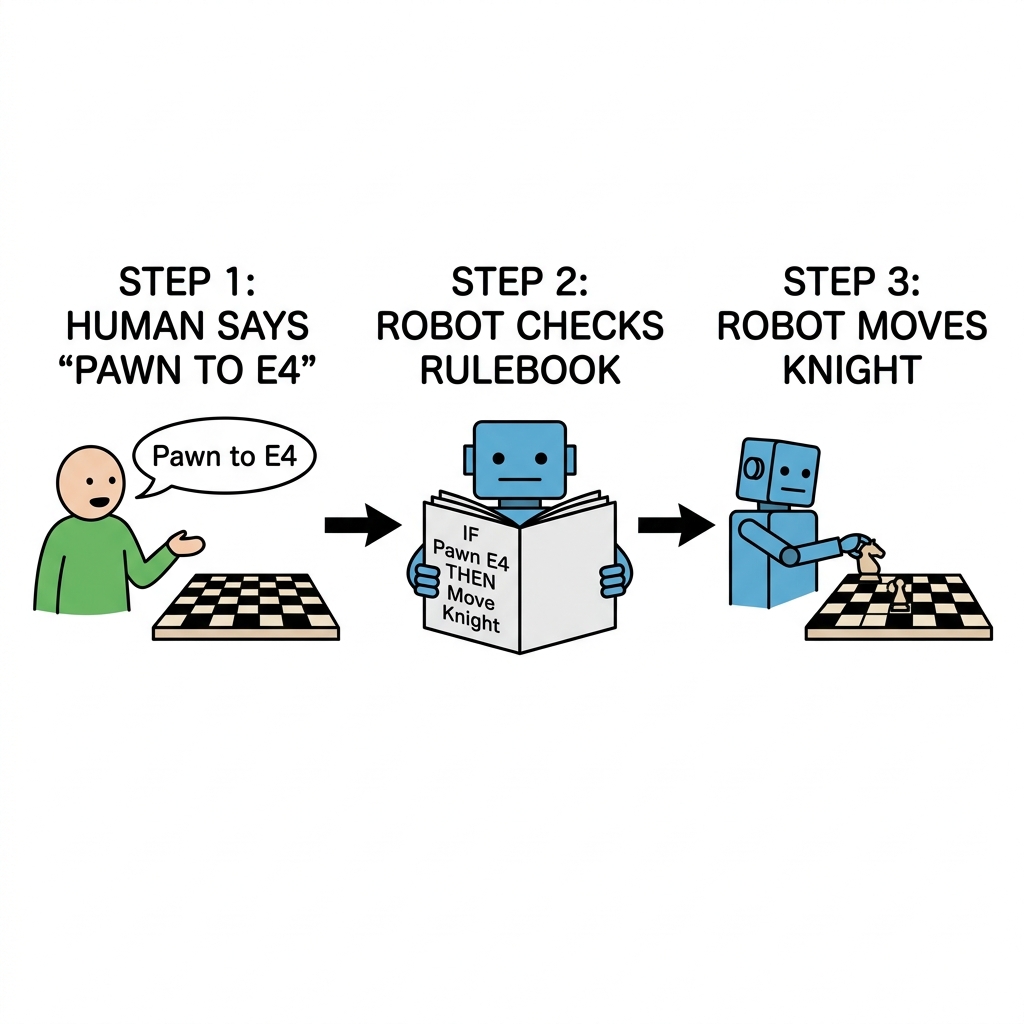
1 The Early Days: "Rule-Following" (1950s - 1990s)
Back in the 1950s, scientists started wondering: Can we make a machine think?
For decades, the answer was basically, "Sort of." Early AI was very rigid. Programmers had to manually type out thousands of rules for the computer to follow. If you wanted an AI to play chess, you had to mathematically define every possible move. It was impressive, but it wasn't creative, and it definitely couldn't learn on its own.
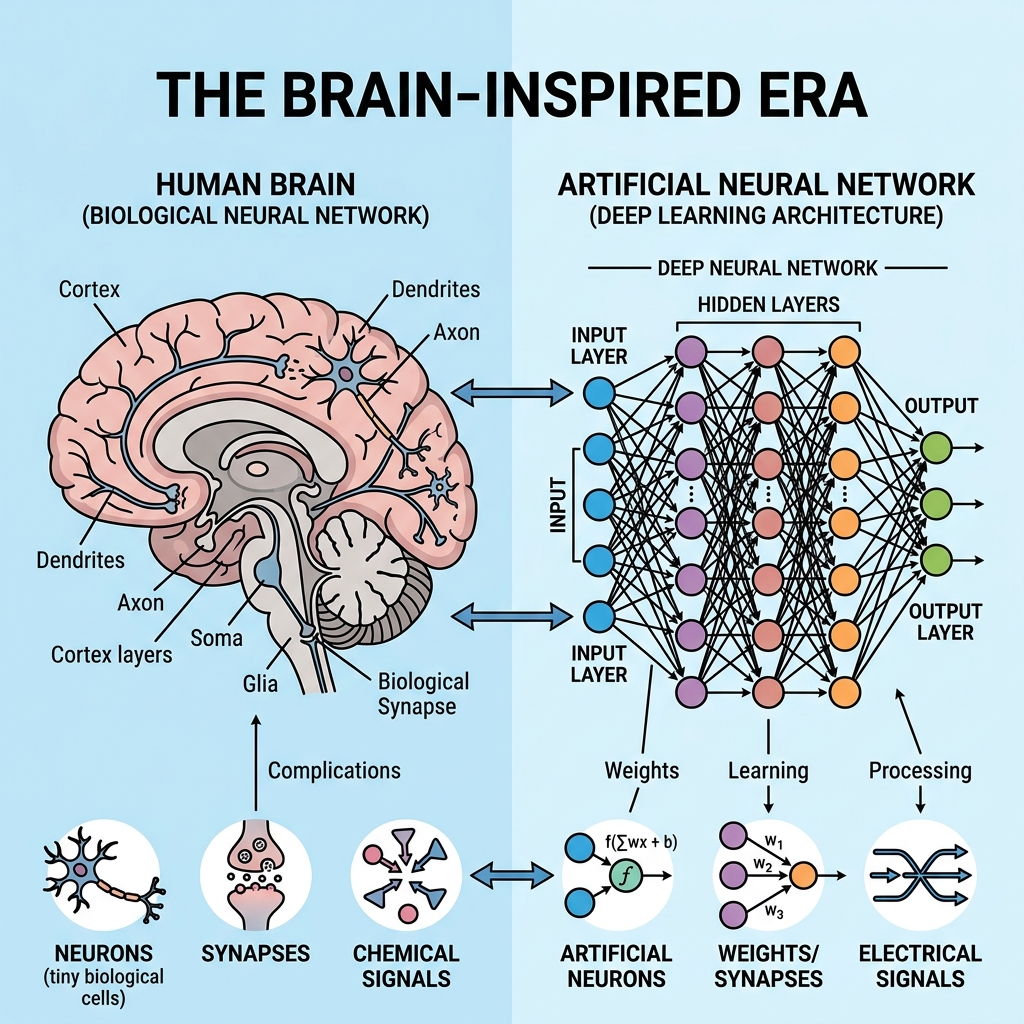
2 The Brain Inspired Era: "Neural Networks" (2010s)
Eventually, scientists realized that writing millions of rules was impossible. Instead, they decided to copy the best thinking machine on Earth: The Human Brain.
They built software called Neural Networks. Instead of giving the computer strict rules, they just gave the computer millions of examples (like showing it 10,000 pictures of dogs) and let it figure out the patterns by itself.
💡 Why did it take so long? Video Games!
The math behind Neural Networks was actually invented in the 1980s. But computers back then were too slow to run it! It wasn't until the 2010s, when super-fast computer chips built for video game graphics (GPUs) became cheap, that AI finally had the horsepower it needed to learn.
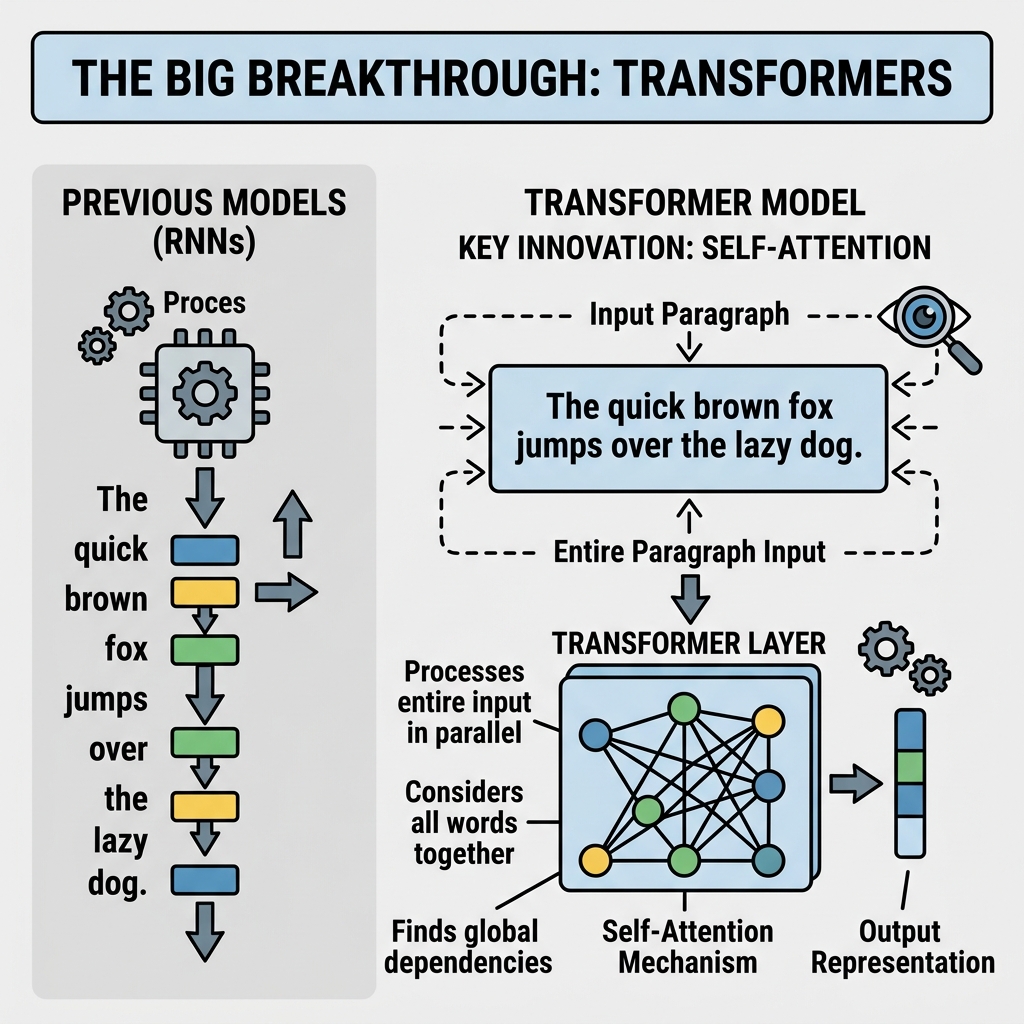
3 The Big Breakthrough: "Transformers" (2017)
Even with Neural Networks, AI struggled with language. If you asked it to translate a sentence, it translated word-by-word, which sounded like a confused robot.
Then, in 2017, researchers at Google invented a new architecture called the Transformer. This changed everything. Transformers allowed the AI to look at an entire paragraph all at once and understand the context of the words, rather than reading it one word at a time.
4 The Generative Explosion (2022 - Present)
With Transformers working behind the scenes, AI stopped just analyzing text and started generating it. In late 2022, OpenAI released ChatGPT to the public. For the first time ever, anyone could talk to a supercomputer using plain English.
Since then, the technology has exploded. We now have models that can generate hyper-realistic images (Midjourney), write computer code, compose music, and even generate full video clips from a single sentence.
📌 Deep Dive: Understanding This Concept
As Generative AI systems become more complex, mastering the underlying principles of This Concept is essential for developers. Proper implementation in this area ensures that your AI applications remain scalable, performant, and secure when deployed to production environments.
Quick Knowledge Check
Test what you just learned
Question 1 of 2
Why did it take until the 2010s for Neural Networks to actually become successful?
Question 2 of 2
What did the "Transformer" invention in 2017 allow AI to do?
Loading results...