📌 What is a Token?
LLMs do not read text letter-by-letter, nor do they strictly read word-by-word. Instead, they process text in chunks called Tokens.
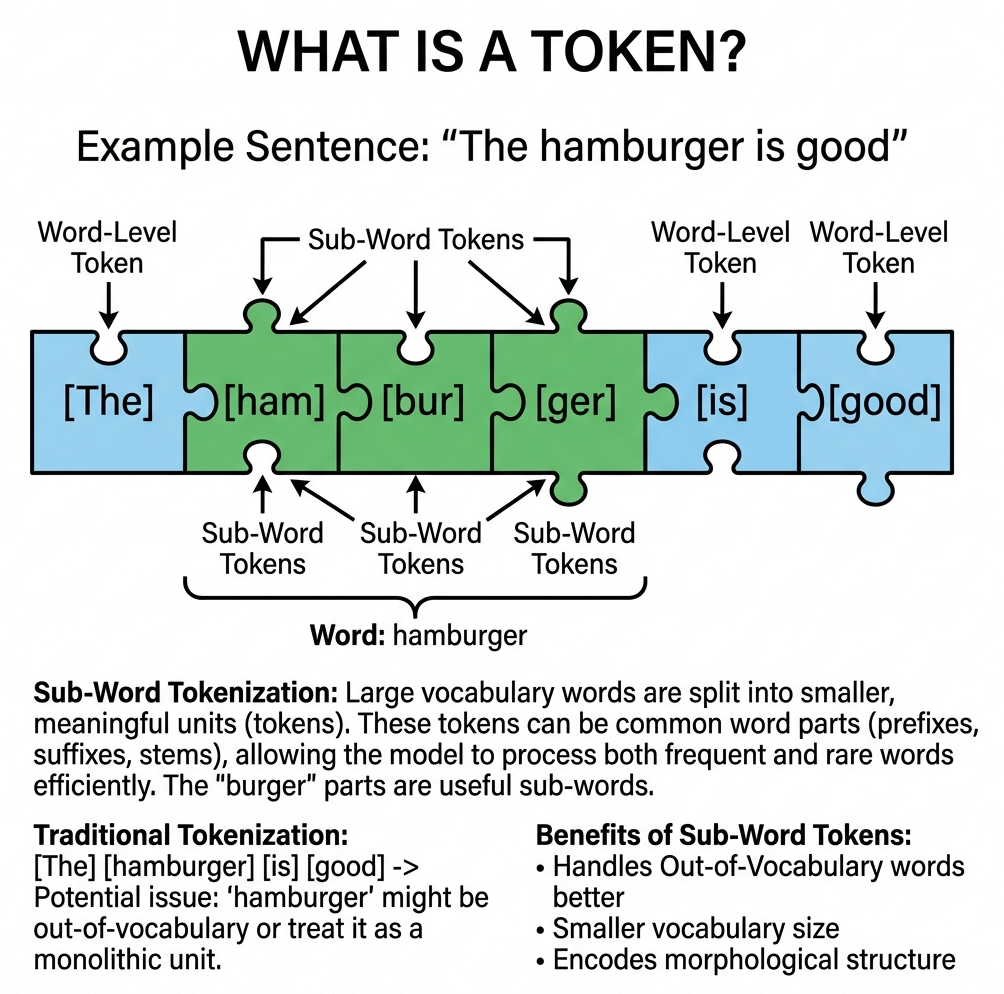
A token can be:
- An entire common word (e.g., "apple")
- A syllable or sub-word (e.g., "ham", "bur", "ger")
- A single character (e.g., "z", or a space)
Rule of Thumb: In English, 1 token is roughly equal to 4 characters, or about ¾ of a word. For example, a 100-token prompt is approximately 75 words.
📌 The Tokenization Pipeline
Before your prompt ever reaches the AI model, it must pass through a Tokenizer. The tokenizer's job is to convert your human-readable text into an array of numerical IDs that the machine can understand.
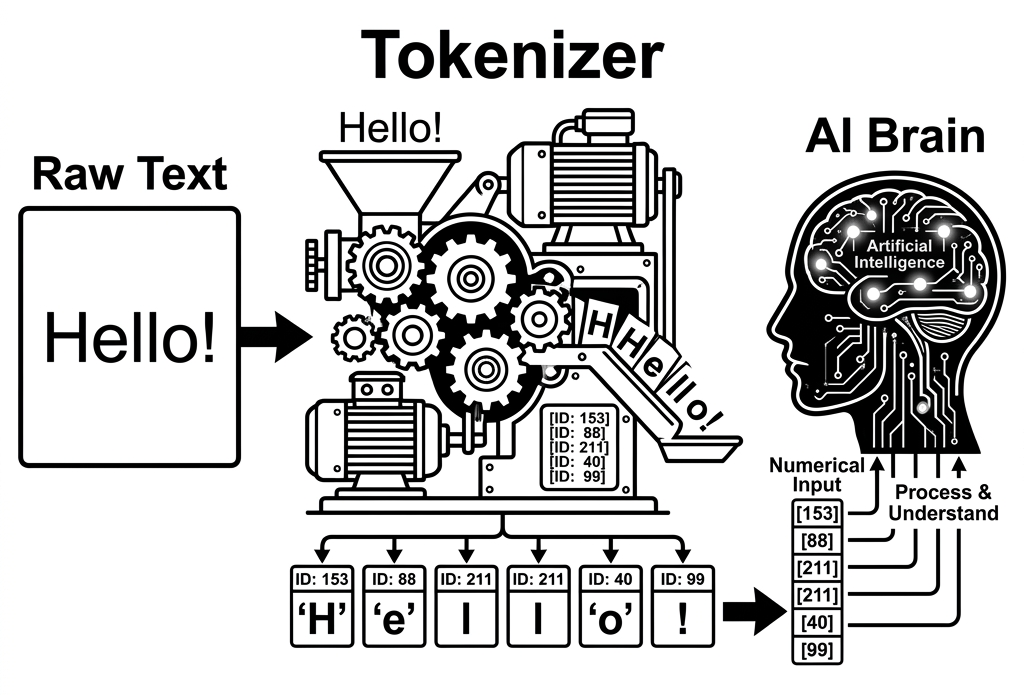
Why do we use tokens instead of just full words?
- Efficiency: There are infinite possible words in all human languages, plus typos, slang, and code. If an LLM had to memorize a unique ID for every possible word, its dictionary would be infinitely large.
- Flexibility: By using sub-word tokens (usually a vocabulary of about 50,000 to 100,000 tokens), the model can construct any word—even words it has never seen before—by combining smaller syllables together.
📌 Examples: How Text is Tokenized
Tokenization algorithms (like Byte-Pair Encoding or WordPiece) can be surprisingly quirky. Small changes in your text can completely change the tokens the model sees.
- Common words are single tokens: "Apple" →
[Apple](1 token) - Capitalization matters: "apple" →
[apple](1 token), but "APPLE" might become[APP][LE](2 tokens) because all-caps words are less common in training data. - Leading spaces matter: " hello" (with a space) is often a completely different token ID than "hello" (without a space).
- Punctuation is separate: "Hello!" →
[Hello][!](2 tokens) - Non-English languages are expensive: Because LLMs are primarily trained on English, a short sentence in English might be 5 tokens, while the exact same sentence in Hindi or Japanese could be 15 tokens, because the model has to break non-English characters down into much smaller sub-pieces (often down to individual bytes).
Quick Knowledge Check
Test what you just learned about Tokens
Question 1 of 1
Why do LLMs use sub-word tokenization instead of just assigning a unique ID to every full word in the dictionary?
Loading results...