Welcome to the world of Generative AI! Over the past few years, artificial intelligence has completely transformed the way we work, learn, and create.
You’ve probably heard of tools like ChatGPT, Gemini, or Midjourney. These are all forms of Generative AI. But what exactly does that mean? In this lesson, we are going to break it down step by step in plain English so you finally understand the magic behind the screen.
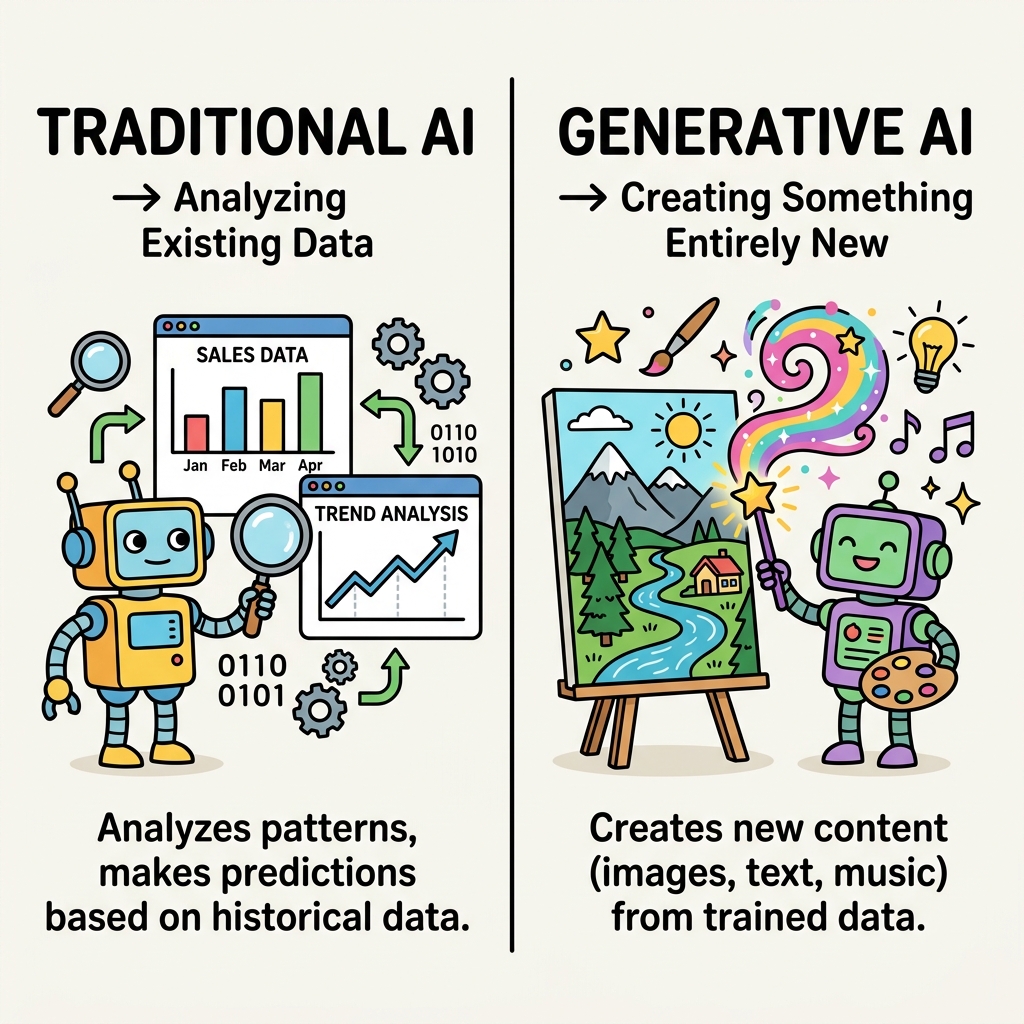
The "Generative" Part Explained
To understand Generative AI, let's look at the word itself: Generate. It means "to make" or "to create."
Traditional computer programs are very strict. If you tell a calculator "2 + 2", it will always say "4". It follows exact rules. Traditional AI was similar—it was great at analyzing things (like predicting the weather or recommending a movie on Netflix based on what you already watched), but it couldn't make anything new.
Generative AI is a massive leap forward. Instead of just analyzing data, it actually generates brand new, original content that has never existed before. It can write essays, compose music, draw pictures, and even write computer code.
💡 A Simple Analogy: The Chef vs The Recipe Follower
Think of traditional software as a person who can only cook by perfectly following a strict recipe card. If an ingredient is missing, they freeze and crash.
Generative AI is like a Master Chef. The Chef has read a million cookbooks (this is the "training data"). You can walk up to the Chef and say, "I have eggs, cheese, and hot sauce—what can I make?" and the Chef will invent a completely new, delicious recipe just for you.
How Does It Know What To Do?
Generative AI models are trained by "reading" vast amounts of information from the internet—millions of books, articles, websites, and images. They study this data to learn patterns.
When you ask a Generative AI to write a poem about a cat, it doesn't just copy and paste an existing poem. Instead, it uses the patterns it learned to predict which words should come next, one by one, until a brand new poem is created. It's essentially the world's most advanced autocorrect!
This remarkable ability is powered by technologies like Large Language Models (LLMs) and neural networks, which we will explore in upcoming lessons.
🎯 Real-World Use Case: Writing an Email
Imagine you need to write a polite but firm email to a client asking them to pay an overdue invoice. This can be stressful and take 20 minutes to write perfectly.
With Generative AI, you simply type: "Write a polite email to a client named Sarah asking her to pay the overdue invoice of $500 by Friday." In three seconds, the AI generates a beautifully written, professional email. You just review it and hit send!
📌 Deep Dive: Understanding This Concept
As Generative AI systems become more complex, mastering the underlying principles of This Concept is essential for developers. Proper implementation in this area ensures that your AI applications remain scalable, performant, and secure when deployed to production environments.
Quick Knowledge Check
Test what you just learned
Question 1 of 2
What makes Generative AI different from traditional computer programs?
Question 2 of 2
In our analogy, how is Generative AI like a Master Chef?
Loading results...