If you've spent any time reading about AI, you have likely heard two words repeated constantly: Training and Inference. Understanding the difference between these two phases is critical to understanding the economics of AI, why AI models hallucinate, and why they have "knowledge cut-off" dates.
Think of it like a student: Training is the years spent going to school, sitting in the library, and studying textbooks. Inference is taking the final exam.
1 The Training Phase (The Heavy Lifting)
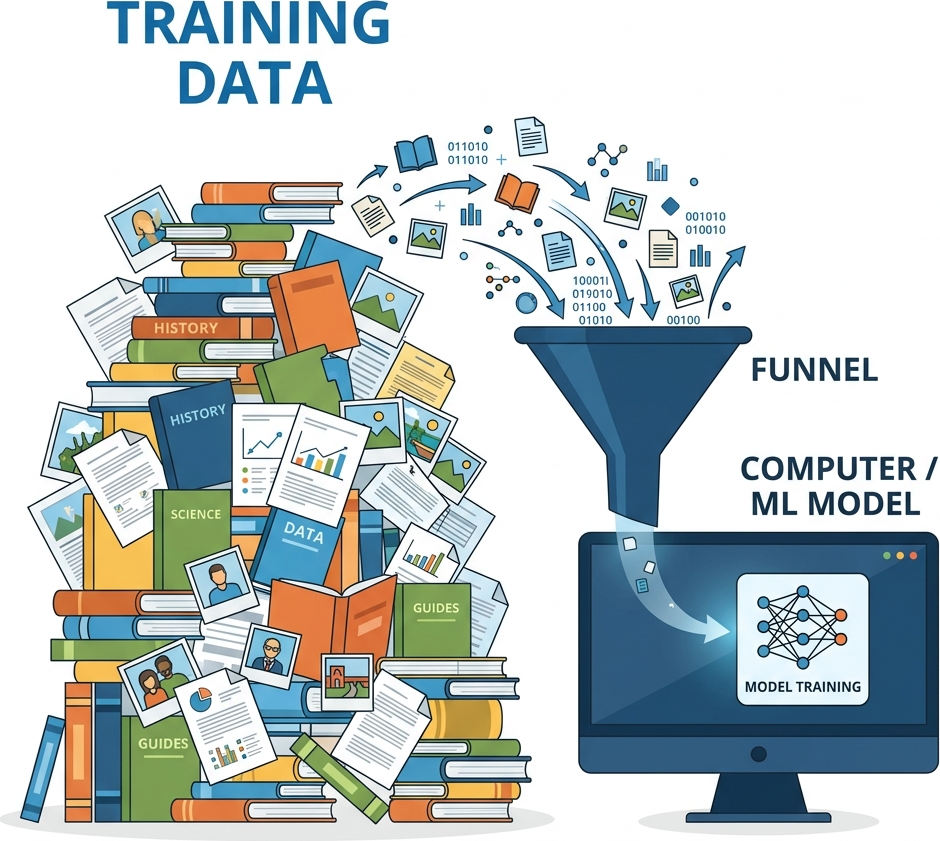
Training is the brutal, computationally exhausting process of actually creating the AI model from scratch. During this phase, the AI is fed massive amounts of data (like the entire public internet) and told to find the patterns.
Cost and Time
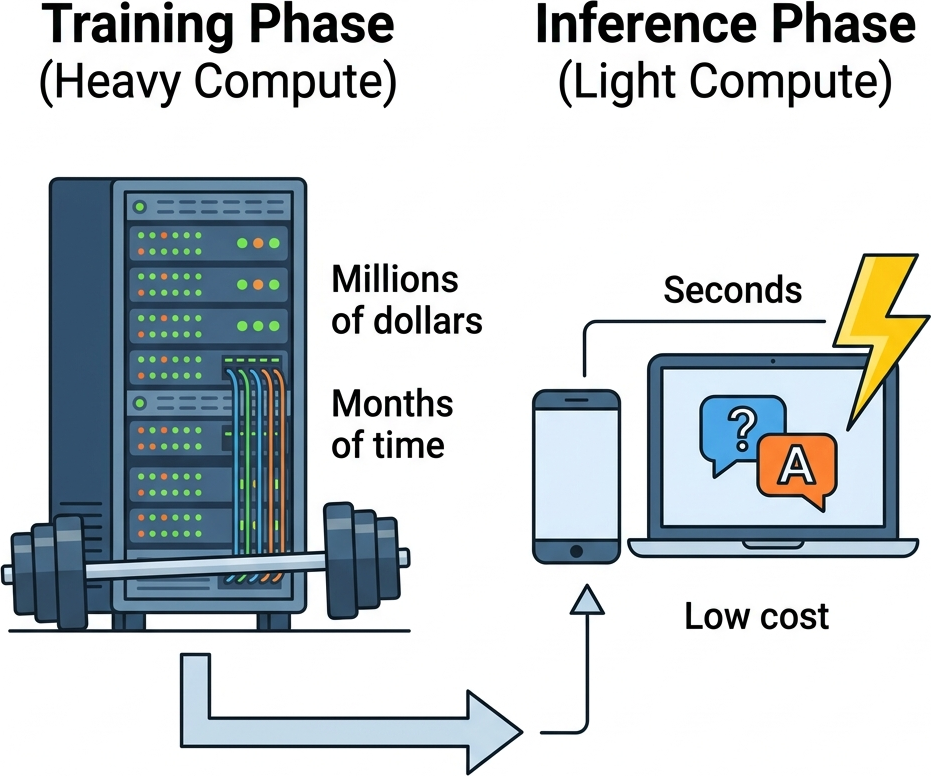
Because the AI is constantly adjusting billions or trillions of mathematical weights to learn these patterns, Training requires specialized supercomputers housed in massive datacenters. Training a top-tier model like GPT-4 takes many months and costs tens or hundreds of millions of dollars in electricity and hardware alone.
Knowledge Cut-Offs
Because training is so expensive and time-consuming, it has to stop eventually. When the training phase ends, the model is "frozen." This is why AI models often don't know about current events—if the training stopped in December 2023, the model's brain is permanently stuck in December 2023.
2 The Inference Phase (The Real World)
Once the model is fully trained and frozen, it enters the Inference phase. This is the phase where you actually use it. When you type a prompt into ChatGPT and it writes an essay, it is performing inference.
Lightweight and Fast
During inference, the model is no longer "learning" or adjusting its weights. It is simply reading your prompt, running it through the frozen mathematical weights it established during training, and predicting the output. Because it isn't learning, inference requires vastly less computing power than training.
While training requires a supercomputer, inference can often be run on a standard server, a laptop, or even a smartphone, and it happens in seconds.
3 Technical Breakdown: Weights and Learning
To put it in slightly more technical terms, it all comes down to Weights.
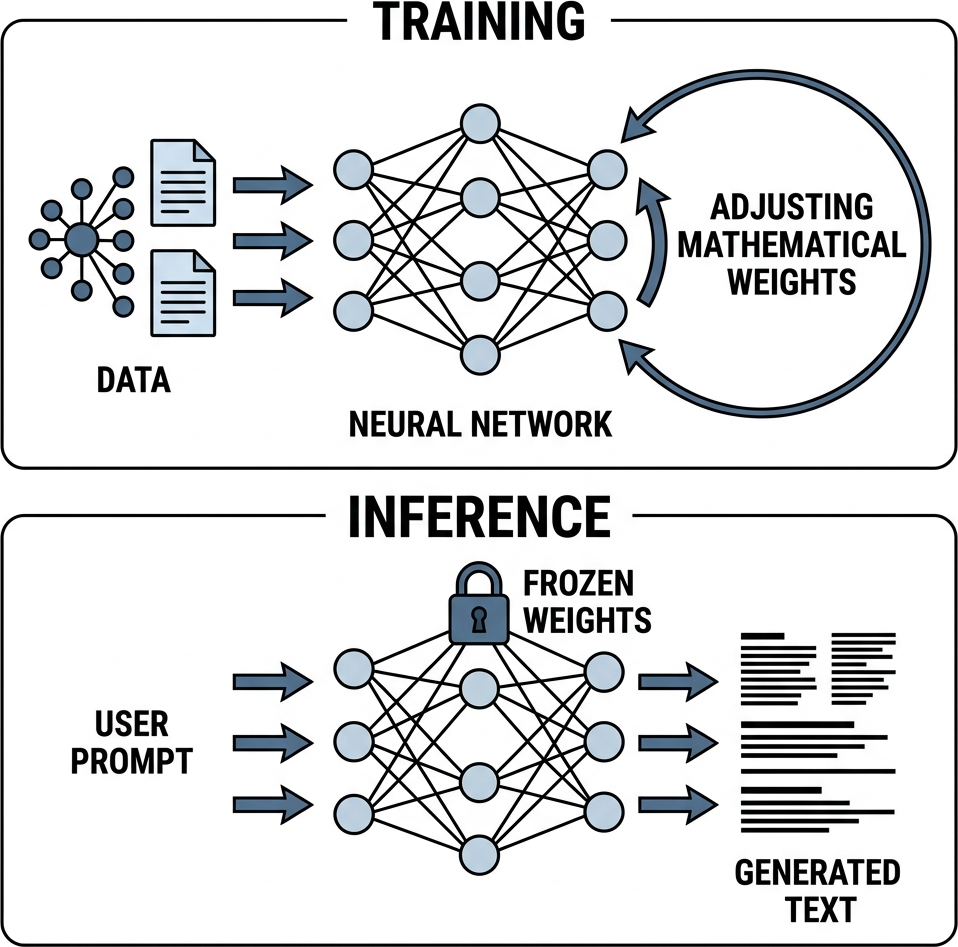
- During Training: The neural network's weights are constantly being updated via a feedback loop. Every time it makes a mistake, it mathematically adjusts its internal connections so it won't make that mistake again.
- During Inference: The neural network's weights are locked. It uses those locked weights to calculate a prediction, but it never adjusts them based on your prompt. (This is why if you teach ChatGPT a new fact in a conversation, it forgets it as soon as you start a new chat—it isn't actually learning during inference).
💡 Summary: Training is the expensive, months-long process of teaching a model by adjusting its weights based on data. Inference is the fast, cheap process of using that frozen model to generate answers.
📌 Deep Dive: Understanding This Concept
As Generative AI systems become more complex, mastering the underlying principles of This Concept is essential for developers. Proper implementation in this area ensures that your AI applications remain scalable, performant, and secure when deployed to production environments.