To understand what Generative AI is, you first have to understand where it comes from. The world of Artificial Intelligence is filled with buzzwords that are often thrown around interchangeably: AI, Machine Learning, and Deep Learning.
While they are all related, they are not the same thing. Understanding the differences between these fields is crucial to understanding why Generative AI is such a massive leap forward.
1 The AI Russian Doll
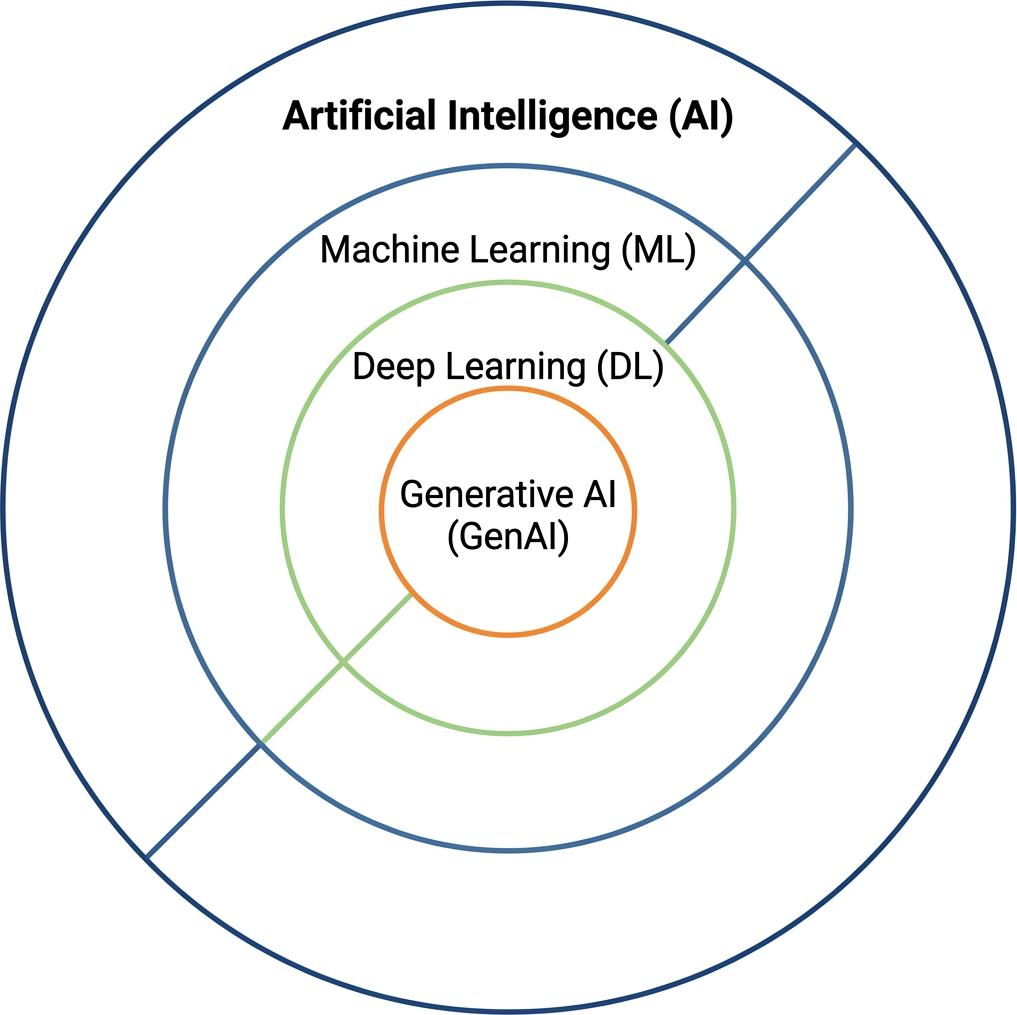
The best way to visualize these concepts is as a set of nested Russian dolls. Each term is a sub-category of the one before it.
- Artificial Intelligence (AI): The broadest concept. It is simply any computer program that can perform a task that normally requires human intelligence (like playing chess or navigating a maze).
- Machine Learning (ML): A specific subset of AI where the computer learns from data without being explicitly programmed with rules.
- Deep Learning (DL): A specific subset of Machine Learning that uses complex Artificial Neural Networks inspired by the human brain.
- Generative AI (GenAI): A specific subset of Deep Learning focused on creating brand new data rather than just analyzing existing data.
2 Machine Learning: The Statistician
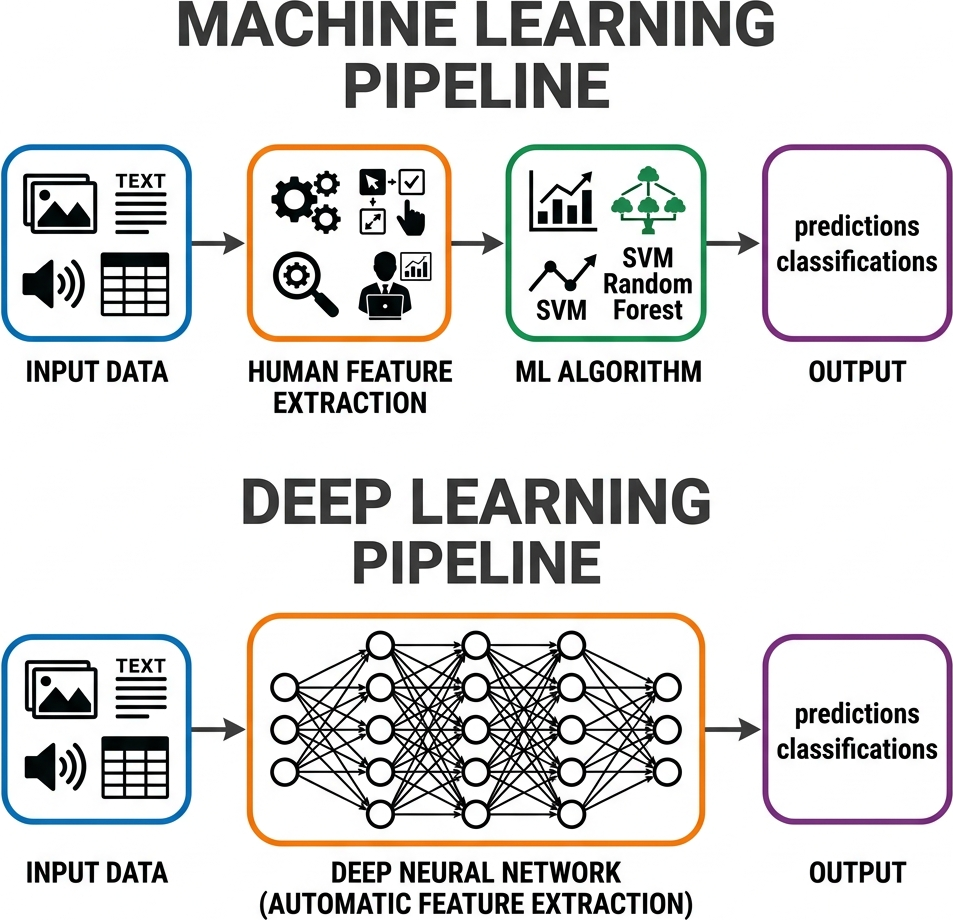
Traditional Machine Learning is incredibly powerful, but it has a major limitation: it relies heavily on humans to tell it what is important. This is called Feature Extraction.
How it Works
Imagine you want to build an ML model to predict the price of a house. You can't just feed the algorithm a picture of the house. A human data scientist has to extract the "features" manually: square footage, number of bedrooms, zip code, and age of the roof. The human puts this structured data into a spreadsheet, and the ML algorithm finds the statistical pattern connecting those features to the price.
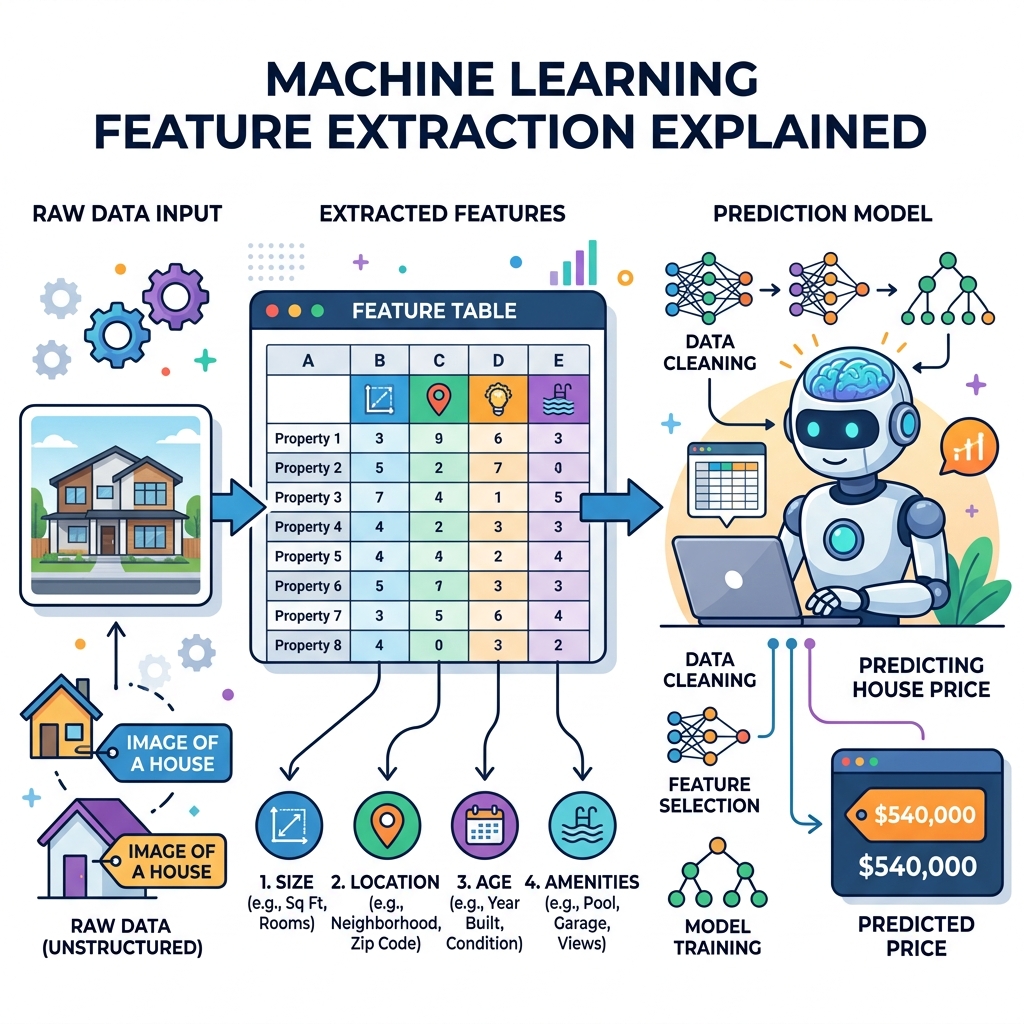
Machine Learning is excellent at dealing with structured data (spreadsheets, databases) but struggles with messy, unstructured data like raw images, audio, or paragraphs of text because humans can't easily extract every single "feature" of a complex photograph.
3 Deep Learning: The Brain
Deep Learning was a revolution because it eliminated the need for human feature extraction. It uses Artificial Neural Networks—multiple layers of interconnected nodes that mimic how human neurons fire.
How it Works
If you want to build a Deep Learning model to recognize a cat in a photo, you don't have to manually tell the computer to look for pointy ears and whiskers. You just feed it millions of raw pixels. The first layer of the neural network learns to detect edges; the next layer learns shapes; the next layer learns textures, until it eventually learns the complete concept of a "cat" entirely on its own.
4 Generative AI: The Creator
For a long time, Deep Learning was primarily used for Analysis and Categorization. It could look at an image and tell you if it was a dog or a cat, or it could listen to audio and transcribe it to text.
Generative AI takes Deep Learning a step further. Instead of just categorizing data, it uses those same neural networks to generate brand new, original data that has never existed before. Instead of identifying a cat in a photo, it can generate a photorealistic image of a cat riding a skateboard on Mars.
💡 Summary: Machine Learning requires humans to extract features from structured data. Deep Learning uses neural networks to automatically extract features from unstructured data. Generative AI uses Deep Learning to create entirely new unstructured data.
📌 Deep Dive: Understanding This Concept
As Generative AI systems become more complex, mastering the underlying principles of This Concept is essential for developers. Proper implementation in this area ensures that your AI applications remain scalable, performant, and secure when deployed to production environments.
Quick Knowledge Check
Test what you just learned
Question 1 of 3
In the "AI Russian Doll" analogy, how are the concepts related?
Question 2 of 3
What is the major limitation of traditional Machine Learning compared to Deep Learning?
Question 3 of 3
How does Deep Learning handle unstructured data like raw images?
Loading results...