📌 The Giants (LLMs)
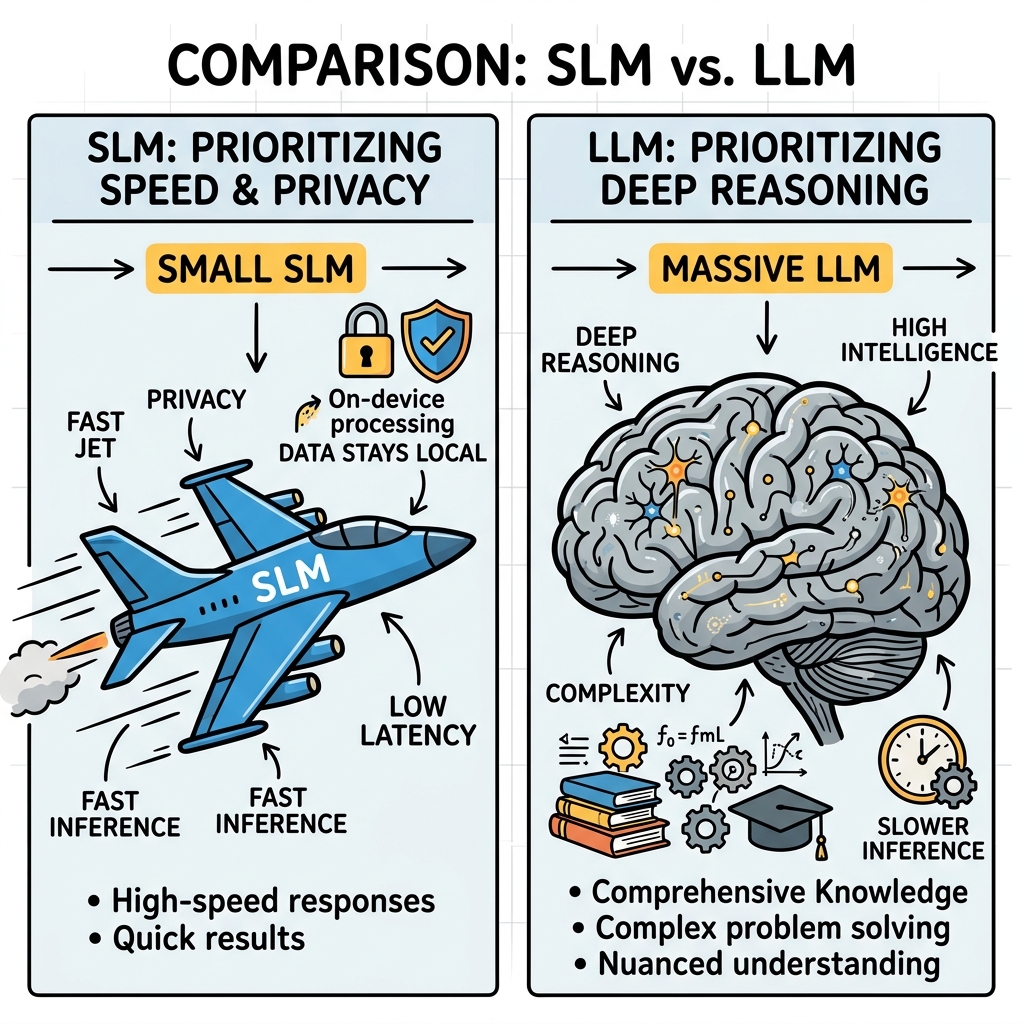
When most people think of Generative AI, they think of LLMs (Large Language Models) like GPT-4 or Claude 3 Opus. These models are absolute behemoths, often containing anywhere from 70 Billion to over 1 Trillion parameters.
The Pros: They possess incredible reasoning capabilities, world-class coding skills, and vast general knowledge.
The Cons: They are physically impossible to run on a normal computer. They require massive cloud server clusters (packed with $40,000 Nvidia GPUs) just to generate a single word. Because they are so massive, they are highly expensive to run (API costs) and suffer from high Latency (they are slow to reply).
📌 The Rise of SLMs (Small Language Models)
Because LLMs are so expensive and slow, the industry recently pivoted to building SLMs (Small Language Models), typically defined as models under 10 Billion parameters (e.g., Microsoft Phi-3, Google Gemma, or Llama 3 8B).
As we learned in the "Scaling Laws" lesson, researchers discovered that if you train a tiny brain on hyper-curated, high-quality data (like actual textbooks instead of random Reddit comments), the tiny brain becomes incredibly smart.
Why do Engineers choose SLMs?
- Latency (Speed): If you are building a real-time voice assistant, you cannot wait 3 seconds for GPT-4 to reply. An SLM can generate text in milliseconds.
- Privacy (Edge Computing): Because SLMs are so small, you can download them directly onto a user's smartphone or laptop. This means the user's data never leaves their device. This is absolutely critical for hospitals, banks, and governments who legally cannot send data to OpenAI's cloud servers.
- Cost: Running an SLM locally on a laptop is completely free.
📌 The Best of Both Worlds: Model Routing
Modern enterprise applications do not limit themselves to just one model. They use an architecture known as Model Routing.
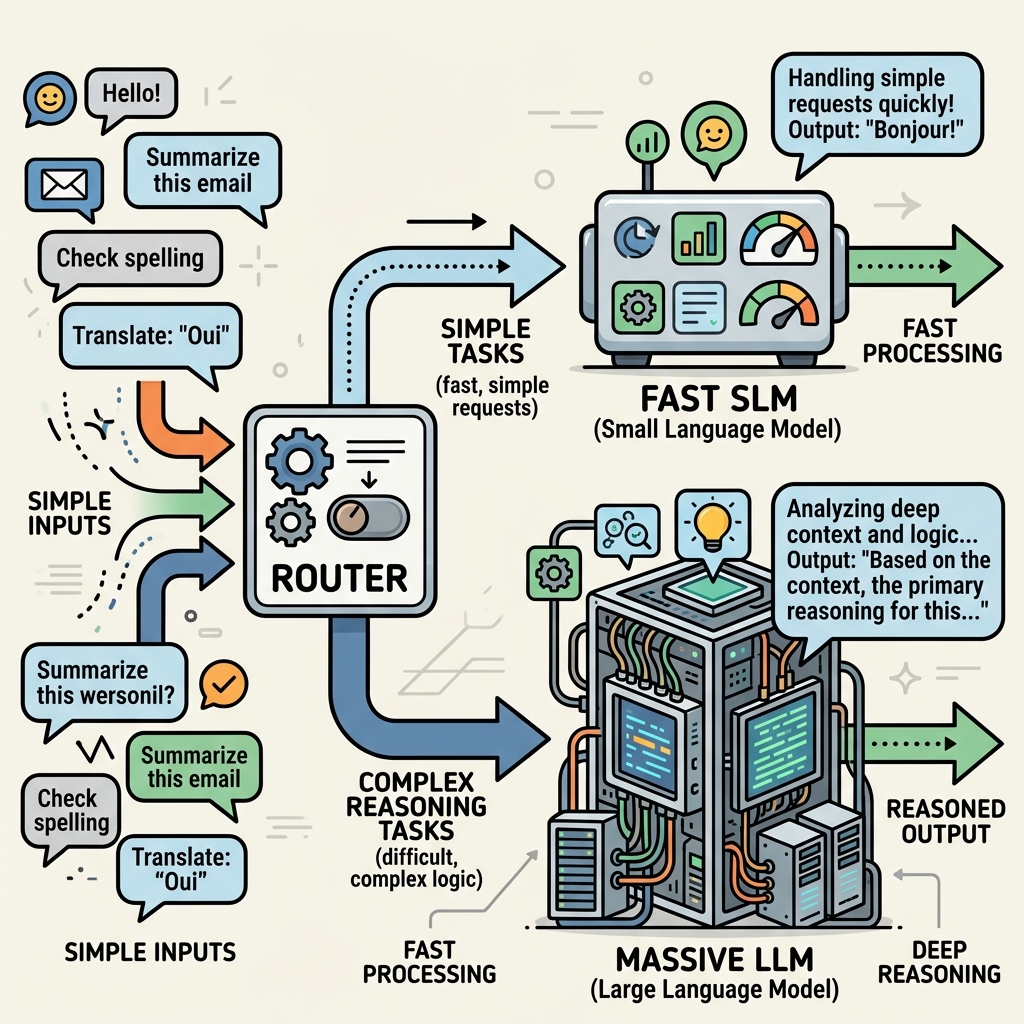
When a user types a prompt into the app, a lightweight "Router" AI reads the prompt and makes a split-second decision:
- If the user asks: "Can you fix the spelling in this email?" — The Router sends this simple task to a fast, cheap SLM on the user's laptop.
- If the user asks: "Can you write a Python script to calculate the trajectory of a rocket?" — The Router instantly forwards this brutal logic puzzle to the massive, expensive GPT-4 API in the cloud.
Quick Knowledge Check
Test what you just learned about SLMs
Question 1 of 1
You are building a medical app for a hospital that summarizes private patient data. By law, the patient data cannot be sent over the internet to a third-party cloud server like OpenAI. How do you solve this?
Loading results...