📌 From Words to Numbers
We know that computers only understand numbers, not words. So how do you feed a sentence into an AI and have it understand the meaning of what you're saying? The answer is Embeddings.
An embedding is a process that translates text (or images, or audio) into a Vector—which is just a long list of decimal numbers, like [0.82, -0.11, 0.45, ...]. The magic is that this list of numbers mathematically represents the semantic meaning of the word.
📌 The Semantic Vector Space
To understand how this is useful, imagine a 3D graph. Let's pretend the X-axis is "Fluffiness", the Y-axis is "Size", and the Z-axis is "Loyalty". If we plot words on this graph:
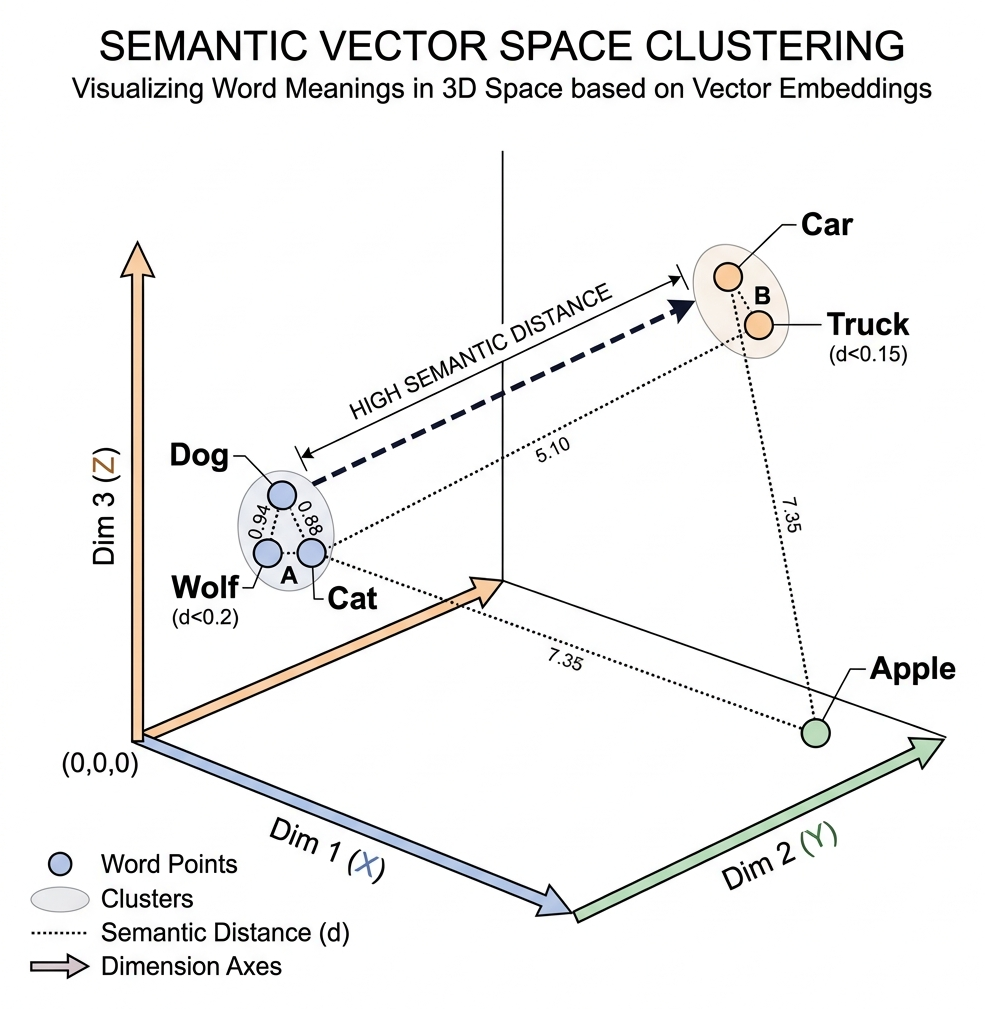
- "Dog" and "Wolf" would be plotted physically very close to each other.
- "Cat" would be nearby, but slightly further away.
- "Car" would be plotted completely across the graph in a different area.
Real embedding models don't just use 3 dimensions. Modern models (like OpenAI's text-embedding-3-small) use 1,536 dimensions! This allows them to capture incredibly nuanced human concepts like sarcasm, tone, grammar, and complex relationships (e.g., the relationship between "King" and "Queen" is mathematically identical to "Man" and "Woman" in this space).
📌 Why do Embeddings Matter?
Embeddings are the secret backbone of modern AI applications. They allow computers to "search by meaning" rather than searching by exact keywords.
- Semantic Search: If you search a database for "Canine Companion", a traditional database looks for exactly those letters. A vector database looks at the embedding and instantly realizes it's clustered right next to "Dog" and "Puppy", returning the correct results even if you didn't use the exact words.
- Recommendation Systems: If you watch three Sci-Fi movies, Netflix looks at the embeddings of those movies and recommends other movies clustered closely in that same vector space.
- RAG (Retrieval-Augmented Generation): When you want an AI to read your company's internal PDFs, you first convert all the PDFs into embeddings and save them in a Vector Database. This allows the AI to instantly fetch the right paragraphs based on the meaning of the user's question.
Quick Knowledge Check
Test what you just learned about Embeddings
Question 1 of 1
What is the primary advantage of using a Semantic Vector Search over a traditional Keyword Search?
Loading results...