To truly understand how to use Generative AI effectively, you must understand its fundamental lifecycle. The entire ecosystem of GenAI can be boiled down to three essential phases: The Data you put in, the Model that processes it, and the Output it produces.
Understanding this "Big Picture" pipeline is critical because it explains both the incredible capabilities and the frustrating limitations of modern AI.
1 The Pipeline Overview
Every Generative AI system follows the same basic journey. It starts with raw, unstructured information. That information is compressed and synthesized into a mathematical engine. Finally, you interact with that engine to generate something new.
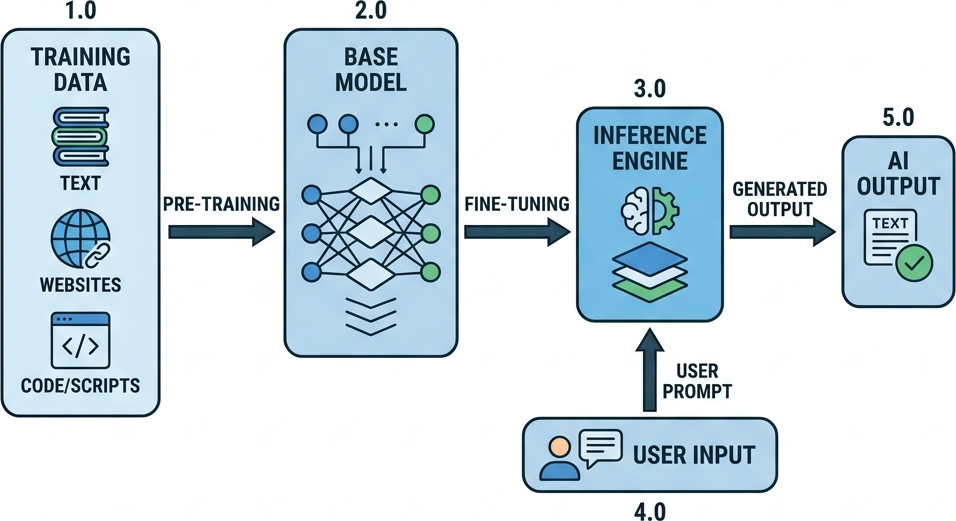
2 Phase One: The Data (The Fuel)
Generative AI models are not programmed with rules; they are trained on examples. Therefore, a model is only as good, as smart, and as unbiased as the data it has consumed.
The Scale of Training Data
Modern Large Language Models (LLMs) like GPT-4 or Gemini are trained on datasets so massive they are difficult to comprehend. We are talking about tens of terabytes of plain text. This includes nearly every public book ever digitized, the entirety of Wikipedia in multiple languages, decades of news articles, and millions of code repositories from platforms like GitHub.
Garbage In, Garbage Out
Because the AI learns by imitating its data, any flaws in the data become flaws in the AI. If the training data contains societal biases, the AI will exhibit those biases. If the data contains outdated information, the AI will confidently state incorrect facts. The data is the model's entire universe.
3 Phase Two: The Model (The Engine)
It is crucial to understand that the Model does not contain a database of the internet. It does not store copies of the books or articles it read.
Compression and Probabilities
Instead, the training process is a massive mathematical compression. The AI analyzes the data to discover the statistical relationships between concepts, words, and pixels. The resulting "Model" is basically a giant file (often hundreds of gigabytes in size) containing billions of numerical weights.
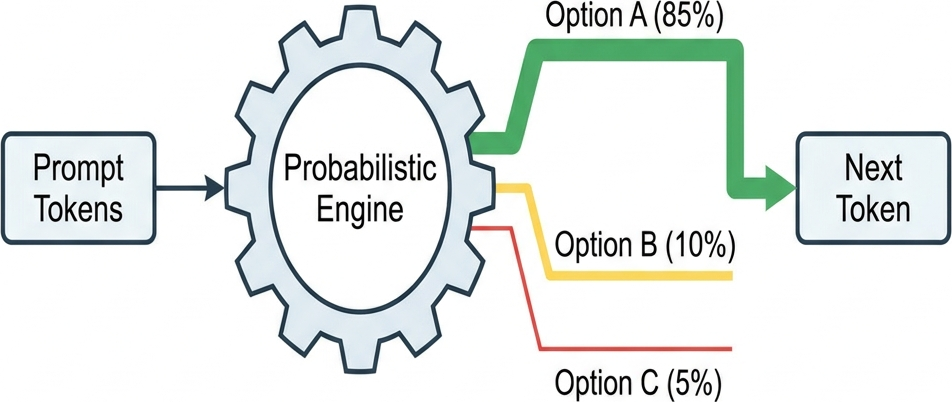
When you ask a model a question, it is not "looking up" the answer in a database. It is calculating the mathematical probability of what the best answer should look like based on the patterns it memorized.
4 Phase Three: The Output (The Destination)
The final phase is Inference—the moment you actually use the model. You provide a Prompt, and the Model generates the Output.
Autoregressive Generation
LLMs generate their output autoregressively, which means they predict and generate one token (part of a word) at a time. After generating a word, it adds that word to your original prompt, reads the whole thing again, and calculates the next word. It does this over and over until it predicts a special "stop" token.
Temperature and Creativity
Because the engine is probabilistic, the output is not deterministic. If there are two good words that could come next, the AI rolls a mathematical dice. This is why you can ask the exact same question twice and get two differently worded answers. This randomness (often controlled by a setting called "Temperature") is what makes the AI seem creative, but it is also what causes it to sometimes "hallucinate" or invent false information.
💡 Summary: The GenAI lifecycle is Data -> Model -> Output. Massive amounts of unstructured Data are compressed into a probabilistic Model, which then uses those statistical patterns to calculate and generate a brand-new Output based on your prompt.
📌 Deep Dive: Understanding This Concept
As Generative AI systems become more complex, mastering the underlying principles of This Concept is essential for developers. Proper implementation in this area ensures that your AI applications remain scalable, performant, and secure when deployed to production environments.