We hear the term "AI" everywhere today. But did you know that the AI making headlines right now is actually a brand-new type of artificial intelligence?
For the last decade, almost all the AI we interacted with was a type called Analytical AI (sometimes referred to as Discriminative AI). However, we have recently entered a totally new era: the era of Generative AI.
So, what exactly is the difference? Why is it such a massive deal? Let's break it down step-by-step so you can easily tell them apart.
Analytical AI (The "Detective")
Think of Analytical AI as a super-fast, highly observant detective. Its main job is to look at existing information, find hidden patterns, and make a decision or prediction based on what it sees. It acts as a judge for data. It asks questions like: "What is this?", "Is this normal?", or "What will probably happen next?"
The key thing to remember is that Analytical AI does not create anything new; it just organizes, categorizes, or scores the information it is given.
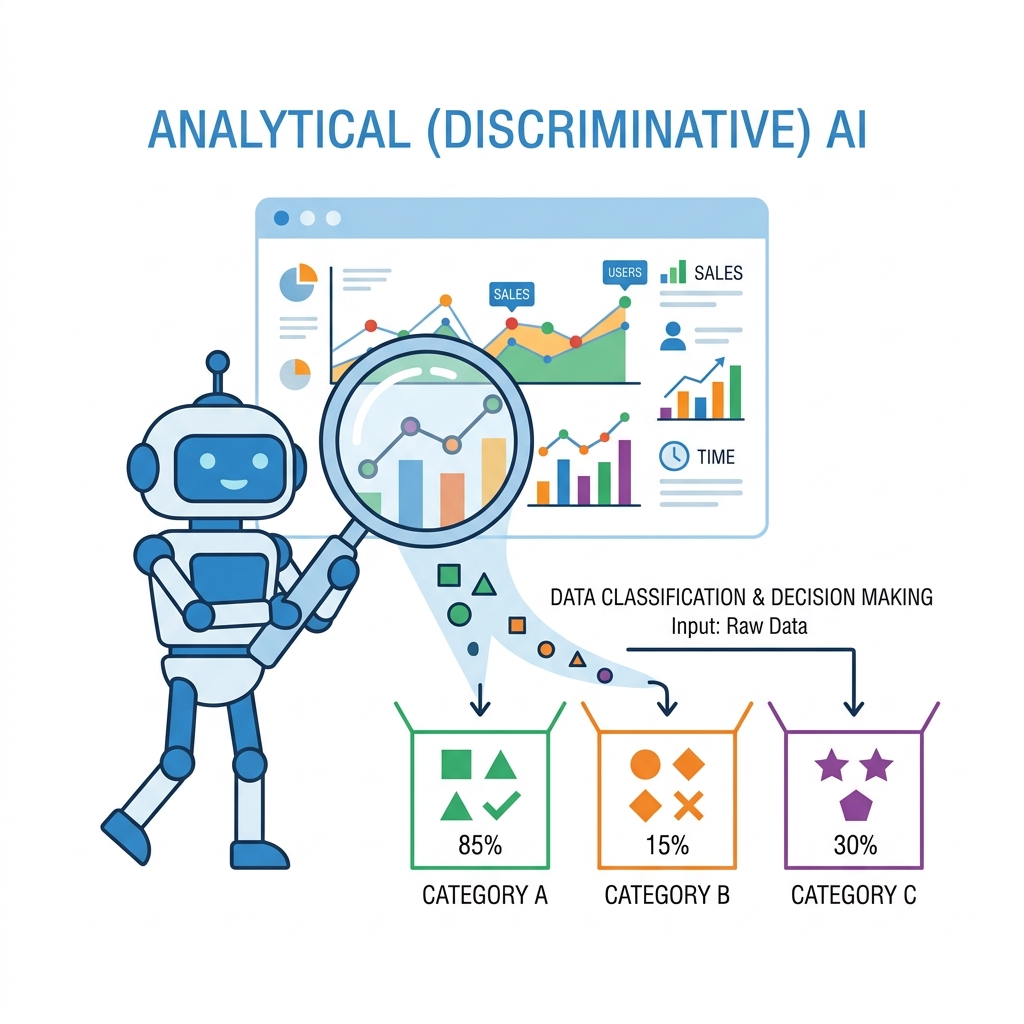
🌍 Real-world Example: Your Email Spam Filter
When you receive a new email, Analytical AI quickly scans it. It checks who sent it, looks for suspicious words, and compares it to millions of other emails. It then makes a firm decision: "This is spam" or "This is safe." Notice that the AI didn't write the email. It just analyzed it and filed it away. That is Analytical AI at work!
If an AI is labeling, sorting, predicting a number, or recommending something from a list, it is almost certainly Analytical AI.
Generative AI (The "Creator")
Generative AI, on the other hand, is like an artist, a writer, or a chef. Instead of just looking at data and categorizing it, it takes everything it has learned and uses it to create brand-new, original content that has never existed before. Instead of asking "What is this?", Generative AI asks: "What can I create based on these instructions?"
This is why tools like ChatGPT and Midjourney feel like magic. They aren't just searching the internet for an answer—they are generating it word-by-word or pixel-by-pixel, just for you.
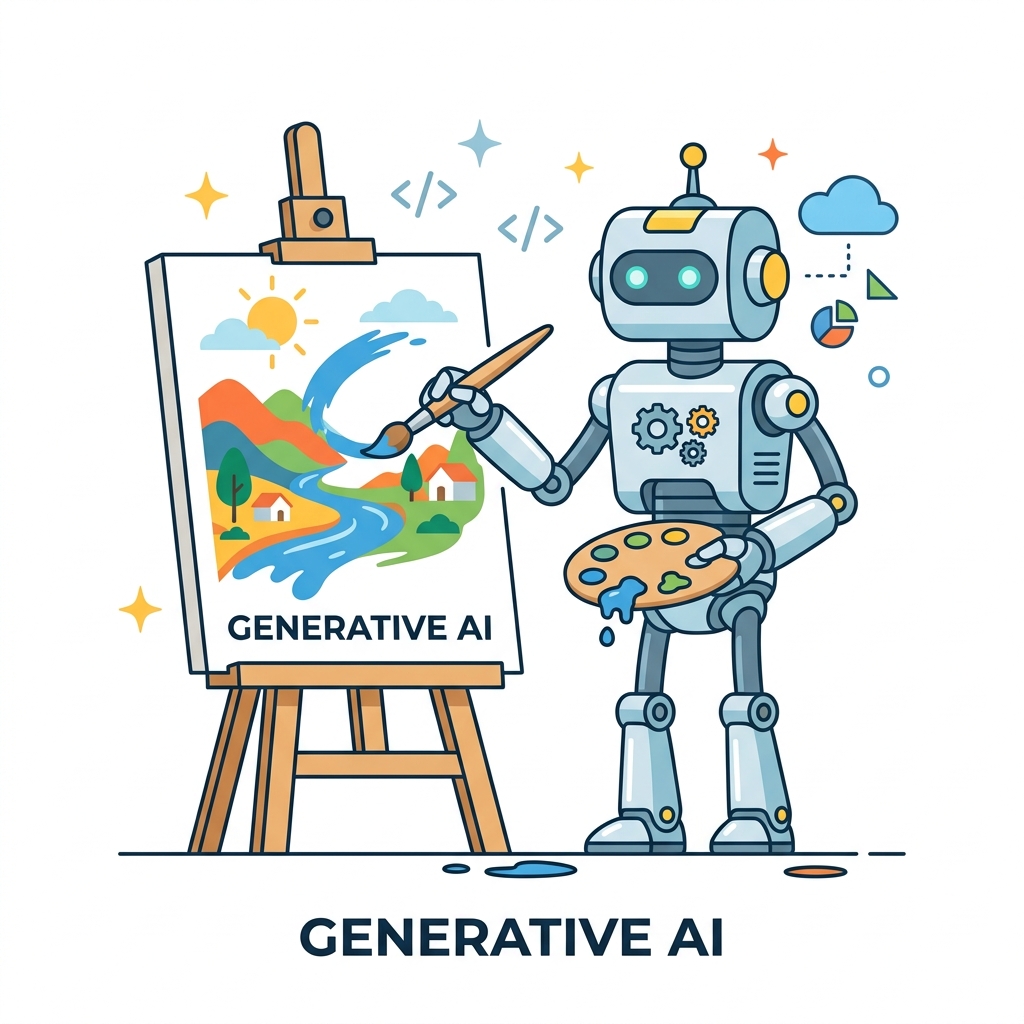
🏢 Industry Use Case: Writing a Cover Letter
Imagine you need a cover letter for a job application. In the past, you would search Google for a template and fill in the blanks yourself. With Generative AI, you simply type: "Write a professional cover letter for a marketing manager position, mentioning my 5 years of experience." In seconds, the AI generates a completely original, personalized cover letter. It didn't just find a file; it wrote it from scratch!
For years, computers have been amazing at doing the math, analyzing spreadsheets, and organizing our files. But the creative work—writing, designing, brainstorming—was always left entirely to humans. Generative AI changes the rules. Now, computers can actually help us create. This doesn't mean it replaces us; instead, it acts as an incredibly fast assistant that can write the first draft, sketch out an idea, or summarize a long document, saving us hours of tedious work so we can focus on the final polish.
| Feature | Analytical AI (The Detective) | Generative AI (The Creator) |
|---|---|---|
| Core Action | Analyzes and predicts | Creates and generates |
| Output Type | Labels, scores, categories, numbers | Text, images, audio, video, code |
| Example | Netflix recommending a movie | ChatGPT writing an email |
📌 Deep Dive: Understanding This Concept
As Generative AI systems become more complex, mastering the underlying principles of This Concept is essential for developers. Proper implementation in this area ensures that your AI applications remain scalable, performant, and secure when deployed to production environments.
Quick Knowledge Check
Test your understanding of the two AI types
Question 1 of 3
Which of the following is an example of Analytical AI?
Question 2 of 3
If you think of Generative AI as "The Artist", what is the best analogy for Analytical AI?
Question 3 of 3
What type of output does Generative AI produce?
Loading results...