We know that a neural network is just a giant web of Weights (volume knobs) and Biases (head starts). But when you first build a network, all of those knobs are set to random numbers.
So how does a completely random pile of math turn into a smart AI? It learns by making mistakes.
1 The Forward Pass (Guessing)
The first step of learning is just making a guess.
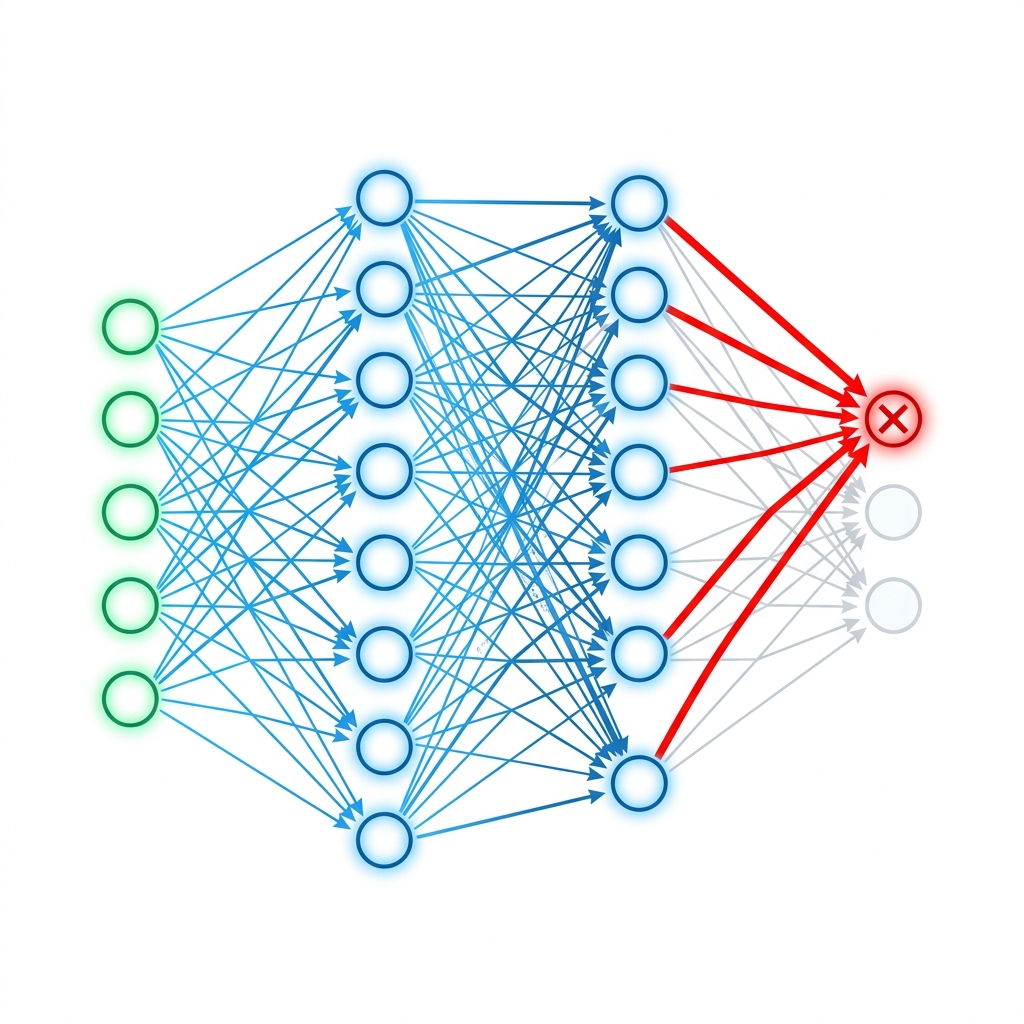
Imagine you show the untrained AI a picture of a Cat. The image data goes into the Input Layer, travels through all the random Weights in the Hidden Layers, and pops out the Output Layer.
Because the weights are random, the AI will probably guess wrong and confidently say: "This is a Dog." This process of data moving forward to make a guess is called the Forward Pass.
2 Backpropagation (Learning from the Mistake)
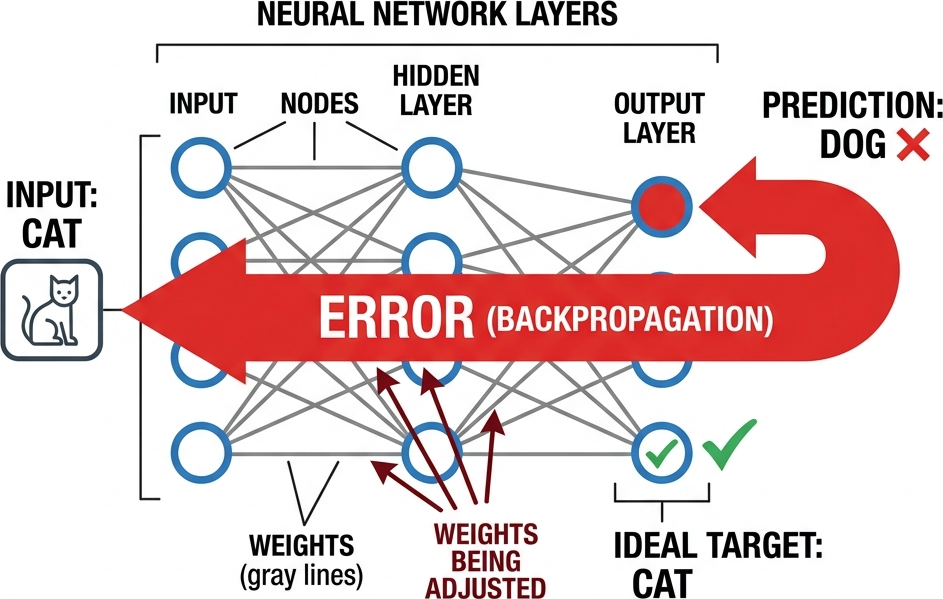
When the AI guesses "Dog," the computer steps in and says, "Wrong. That was a Cat."
The network now calculates exactly how wrong it was (this is called the Error or the Loss). Then, an incredible mathematical trick called Backpropagation happens.
The Error signal travels backwards through the network. It looks at every single Weight that contributed to the bad guess and adjusts it slightly. It turns down the knobs that led to "Dog" and turns up the knobs that lead to "Cat."
3 Gradient Descent (Finding the Bottom)
The AI does this Forward Pass and Backpropagation dance millions of times with millions of different pictures.
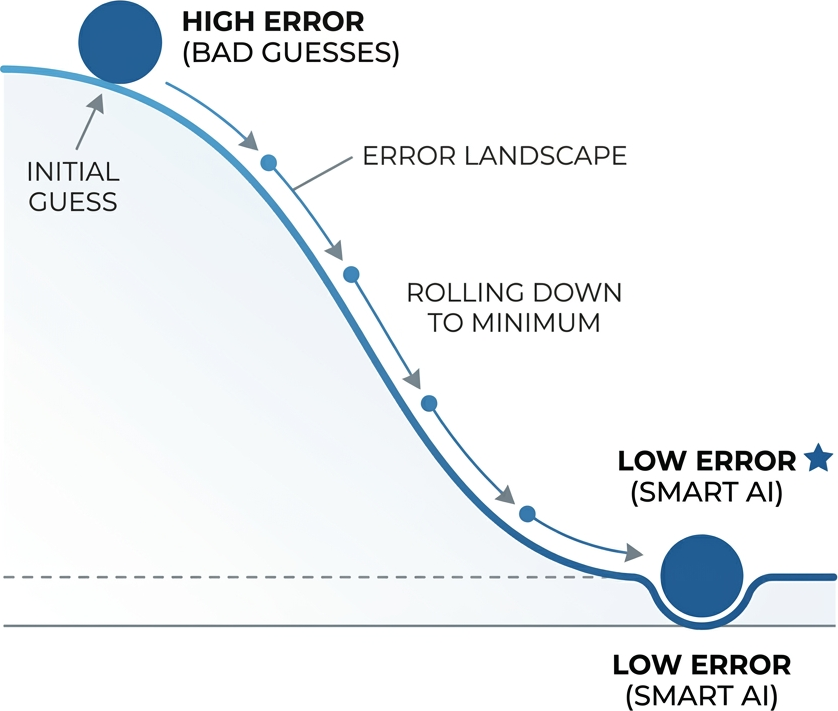
Computer scientists call this process Gradient Descent. Imagine a ball rolling down a curved hill. The top of the hill is "High Error" (the AI is stupid and guessing randomly). The bottom of the valley is "Low Error" (the AI is smart and guessing correctly).
Every time the AI adjusts its weights, the ball takes one tiny step down the hill. It keeps adjusting until it reaches the very bottom.
💡 Summary: An AI learns by guessing (Forward Pass), realizing it made a mistake, and working backwards to adjust its weights (Backpropagation). It repeats this until it reaches the lowest possible error (Gradient Descent).
📌 Deep Dive: Understanding This Concept
As Generative AI systems become more complex, mastering the underlying principles of This Concept is essential for developers. Proper implementation in this area ensures that your AI applications remain scalable, performant, and secure when deployed to production environments.