Idiomatic JavaScript means writing code that is clear, concise, and follows the common patterns and style conventions favored by experienced JavaScript developers. This improves readability, maintainability, and helps you leverage JavaScript’s strengths effectively.
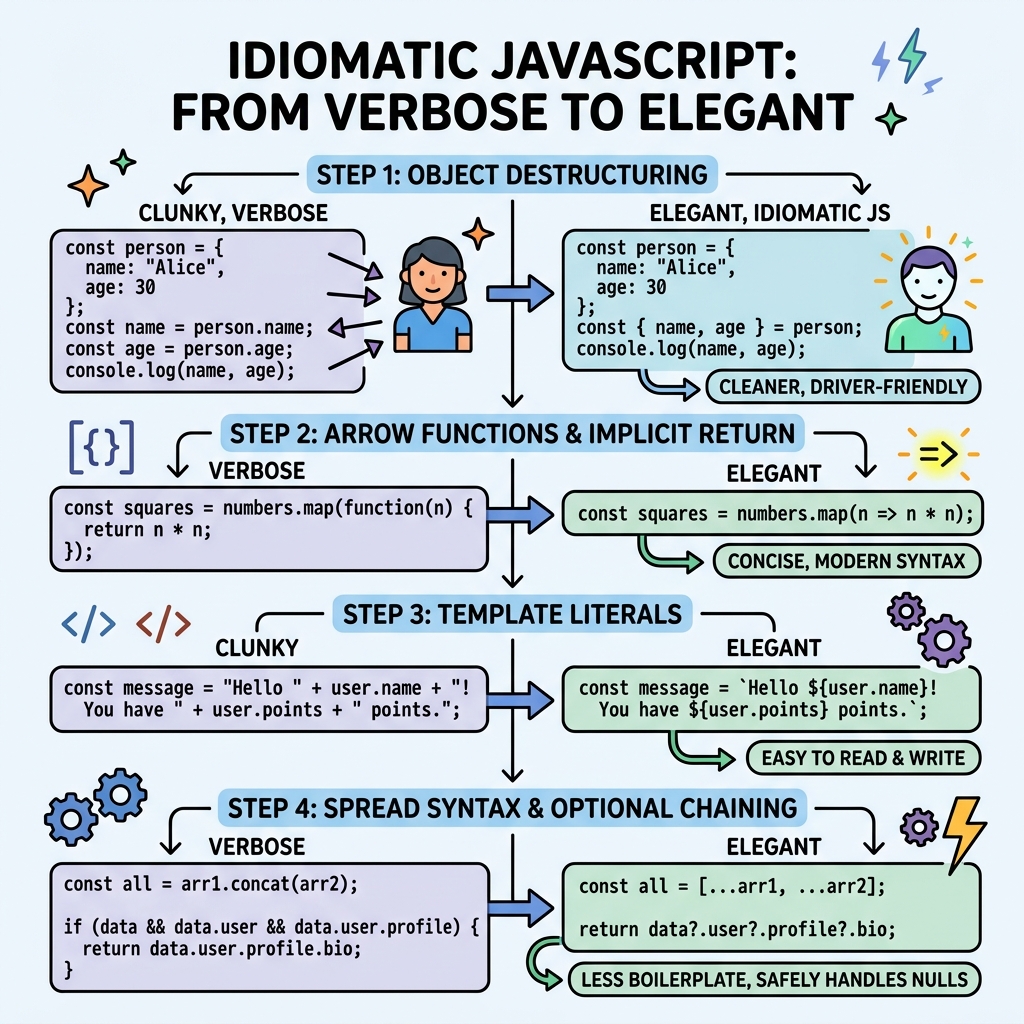
💡 Why Idiomatic JavaScript?
Readable code reduces bugs, eases collaboration, and scales better in projects. Idiomatic style embraces JavaScript’s unique features rather than forcing it into other languages' paradigms.
Key Practices in Idiomatic JavaScript
- Use
constandletinstead ofvar— block-scoped declarations improve clarity and prevent bugs. - Prefer arrow functions for concise function expressions especially for callbacks.
- Use template literals instead of string concatenation for clearer and more readable strings.
- Favor array methods (
map,filter,reduce) over loops for data transformation. - Destructure objects and arrays to extract values cleanly and reduce boilerplate.
- Write short, focused functions that do one thing well.
- Use default parameters to simplify function signatures.
Examples of Idiomatic vs. Non-Idiomatic
| Non-Idiomatic | Idiomatic |
|---|---|
var name = "Alice"; | const name = "Alice"; |
var count = 0; | let count = 0; |
| Non-Idiomatic | Idiomatic |
|---|---|
function add(a, b) { return a + b; } | const add = (a, b) => a + b; |
const nums = [1,2,3]; | const squares = nums.map(n => n * n); |
| Non-Idiomatic | Idiomatic |
|---|---|
const greeting = "Hello, " + name + "!"; | const greeting = `Hello, ${name}!`; |
Destructuring for Cleaner Code
Extract values directly from objects or arrays instead of accessing properties repeatedly:
📌 Deep Dive: Object Destructuring
const user = { name: "Alice", age: 25, city: "NY" };
const { name, age } = user;
console.log(name, age);Default Parameters Simplify Functions
Set default values for parameters to avoid manual checks:
📌 Deep Dive: Default Parameters
function greet(name = "Guest") {
  return `Hello, ${name}!`;
}
console.log(greet());       // Hello, Guest!
console.log(greet("Sam")); // Hello, Sam!Hello, Sam!
⚠️ Avoid Overly Complex One-Liners
While concise code is good, readability matters more. Choose clarity over clever tricks or dense chaining.
💡 Summary
- Use
const/letovervar - Prefer arrow functions and array methods
- Leverage destructuring and template literals
- Write small, reusable functions with defaults
- Favor readability and common idioms for maintainable code
Quick Knowledge Check
Test what you just learned
Question 1 of 2
Which is the preferred way to declare a variable that will not be reassigned?
Question 2 of 2
What is an idiomatic way to iterate over an array to create a new array of transformed items?
Loading results...