📌 The Long Tail Problem
To understand why we need Top-K and Top-P, we must understand the "Long Tail". An LLM's vocabulary contains tens of thousands of words. Even if a word is completely nonsensical in the current context, the model assigns it a probability greater than 0% (e.g., 0.00001%).
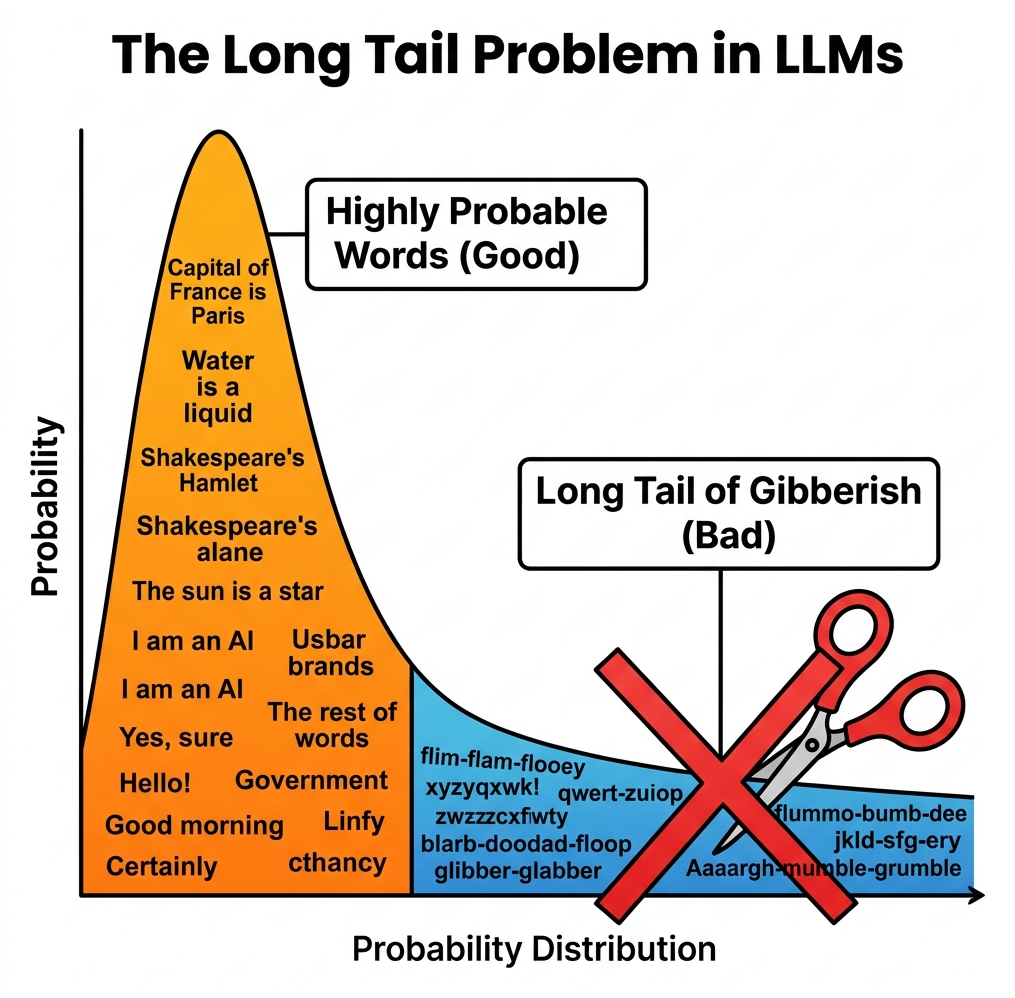
If you turn up the Temperature without using Top-K or Top-P, the sum total probability of those 40,000 "terrible" words becomes significant. The model will occasionally pick from the tail, outputting total gibberish.
📌 Top-K: The Hard Cutoff
Top-K solves the long tail problem by enforcing a strict, hard cutoff based on rank. If you set Top-K = 40, the model will only ever consider the 40 most likely words, completely ignoring the 41st and below.
The problem with Top-K: It's too rigid. Imagine the model is extremely confident, and only 2 words make sense (each with 49% probability). Top-K=40 will still include 38 terrible words in the pool just to hit the quota of 40.
📌 Top-P (Nucleus Sampling): The Dynamic Cutoff
Top-P is a much smarter approach. Instead of counting words, it sums up their probabilities until it hits the threshold P.
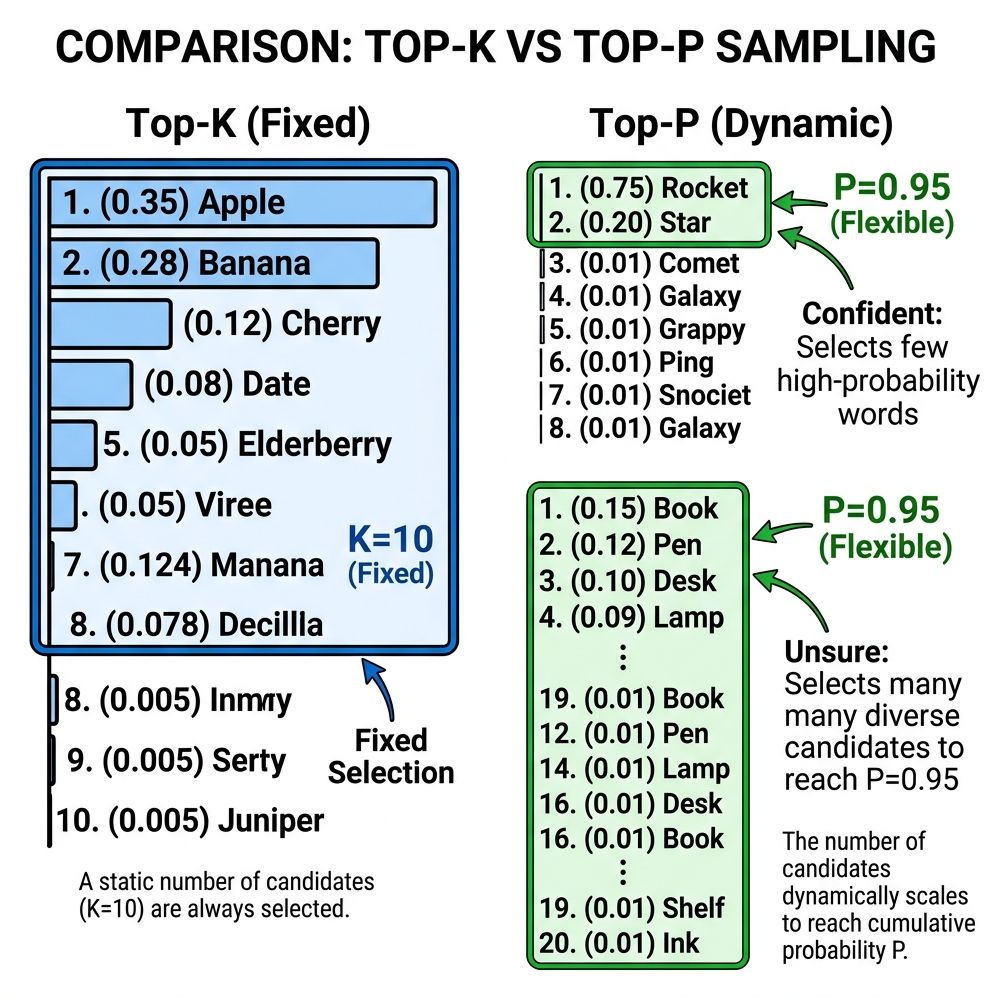
If you set Top-P = 0.90:
- High Confidence Scenario: If word A is 50% and word B is 40% likely, their sum is 90%. Top-P will cut off the list at exactly 2 words.
- Low Confidence Scenario: If the model is unsure and the top 50 words each have a 1.8% chance, Top-P will include all 50 words to reach the 90% threshold, allowing the model to be more creative.
For this reason, most modern applications rely heavily on Top-P (Nucleus Sampling) over Top-K.
Quick Knowledge Check
Test what you just learned about Nucleus Sampling
Question 1 of 1
Why is Top-P generally preferred over Top-K in modern LLM applications?
Loading results...