If you feed an AI bad data, it becomes a bad AI. But it isn't just about the quality of the data—it is also about how messy the data is.
In the world of AI, there are two main types of data: Structured and Unstructured. Let's look at the difference.
1 Structured Data (The Clean Data)
Structured Data is data that is highly organized and easy for a computer to read.
Think of an Excel spreadsheet. Everything is in a neat row and column. If a computer wants to know the price of an item, it just looks at row 5, column B. It is mathematical, precise, and perfectly organized.
Older AI models loved structured data because it was so easy to understand.

2 Unstructured Data (The Messy Data)
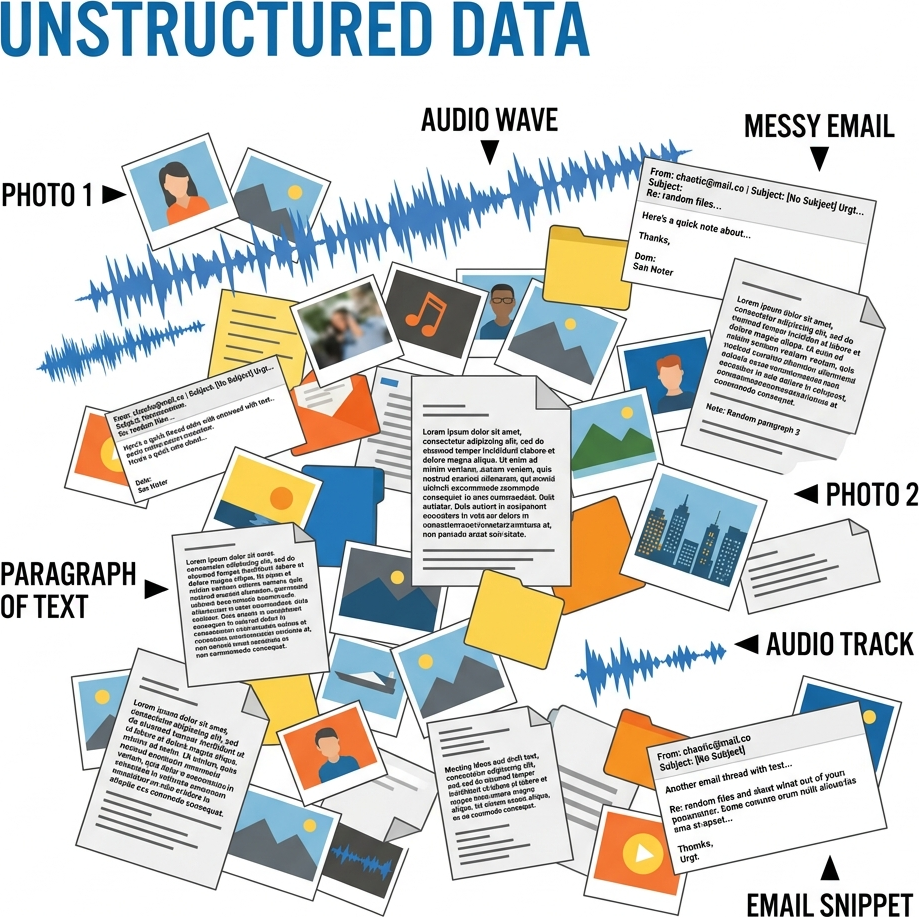
Unstructured Data is exactly what it sounds like: a total mess.
It is raw text in a book, spoken audio in a podcast, or pixels in a photograph. There are no neat rows or columns. It is chaotic.
For decades, computers were completely blind to unstructured data. They could not understand a photograph or summarize a book.
3 Why Generative AI is a Big Deal
The reason Generative AI (like ChatGPT) is such a massive revolution is because it finally solved the unstructured data problem.
Generative AI doesn't need neat spreadsheets. You can hand it a messy PDF, a chaotic photograph, or a rambling voice note, and it will understand it perfectly. It is the first technology in history that can organize the messy, human side of the internet.
💡 Summary: Structured data is neat and organized (like spreadsheets). Unstructured data is messy (like books and photos). Generative AI is powerful because it is the first AI that can easily understand unstructured data.
📌 Deep Dive: Understanding This Concept
As Generative AI systems become more complex, mastering the underlying principles of This Concept is essential for developers. Proper implementation in this area ensures that your AI applications remain scalable, performant, and secure when deployed to production environments.