📌 What is Prompt Chaining?
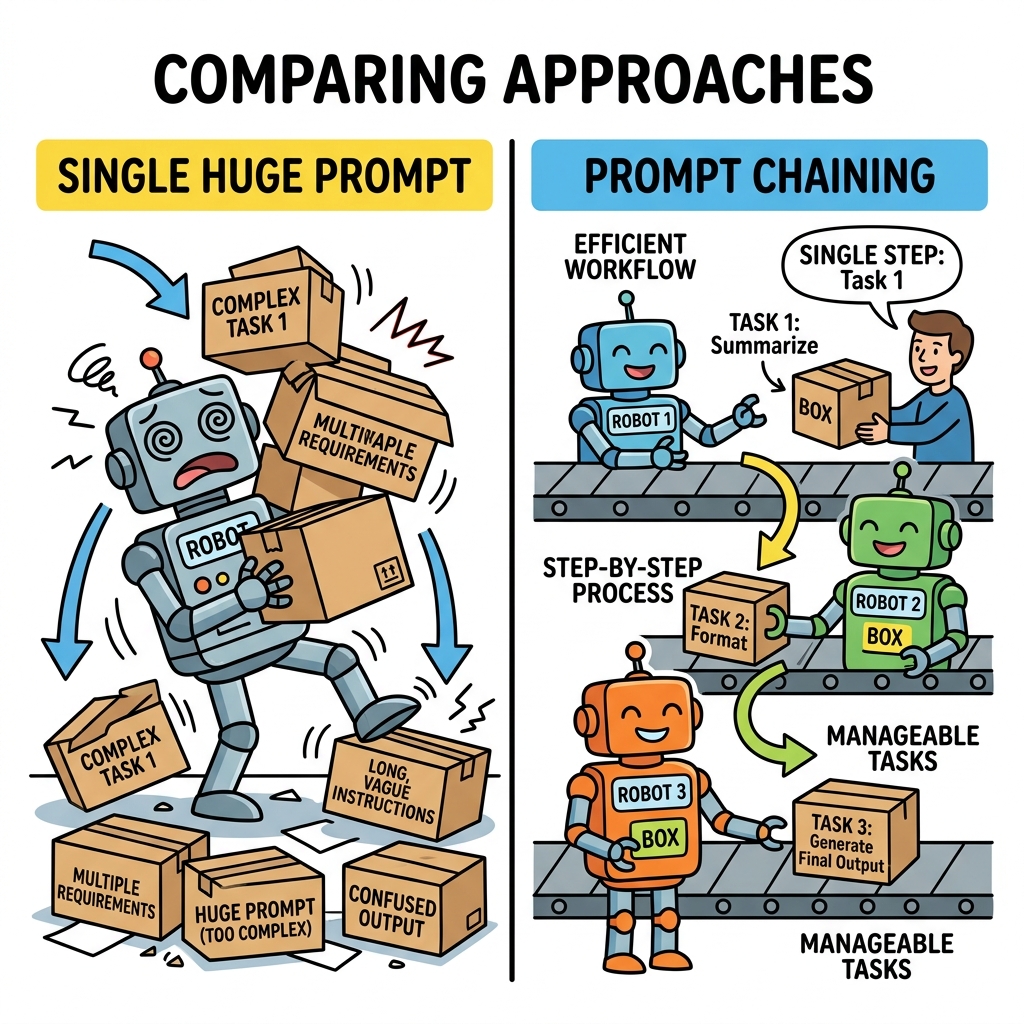
If you ask an AI to "research the history of Rome, write a 10-page essay, format it in markdown, and translate it to Spanish," the AI will likely struggle, hallucinate, or lose track of instructions. This is called a "mega-prompt."
Prompt Chaining is the technique of breaking down a large, complex task into a series of smaller, focused prompts. The output of the first prompt is used as the input for the second prompt, and so on.
📌 Why should you use Prompt Chaining?
- Higher Quality: An LLM focused on a single task (e.g., "Just write an outline") performs much better than one juggling ten tasks.
- Easier Debugging: If a mega-prompt fails, you don't know where it went wrong. In a chain, if step 3 fails, you just fix the prompt for step 3.
- Human in the Loop: Chaining allows you to review the output of Step 1 before feeding it to Step 2.
- Bypass Token Limits: Generating a massive document in one go might hit the output token limit. Chaining lets you generate it section by section.
📌 Example: The Article Writing Pipeline
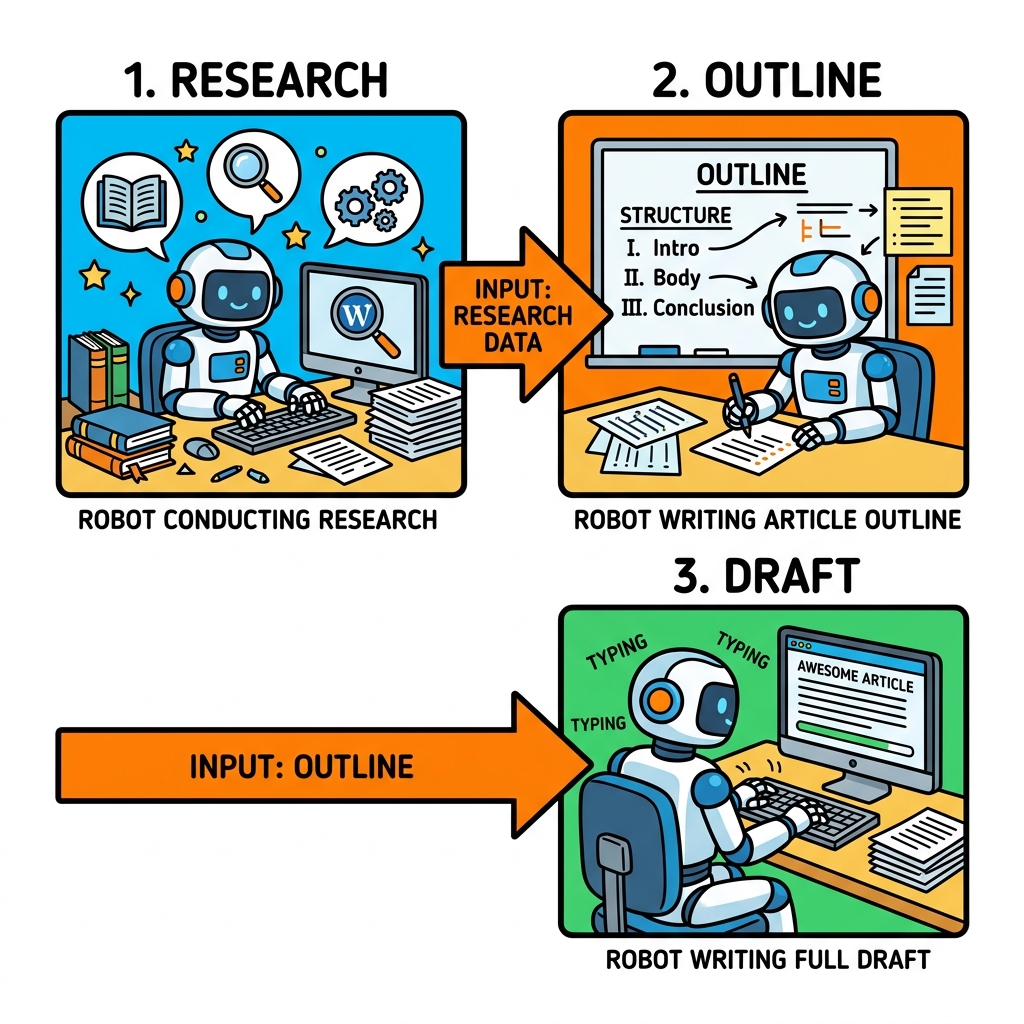
Instead of one prompt to write an article, a standard prompt chain looks like this:
- Prompt 1 (Research): "Extract the 5 most important facts from this document."
- Prompt 2 (Outline): "Using these 5 facts: [output of Prompt 1], create a 3-section outline."
- Prompt 3 (Draft): "Using this outline: [output of Prompt 2], write the first draft."
Quick Knowledge Check
Test what you just learned about Prompt Chaining
Question 1 of 1
What is the primary benefit of breaking a large task into a prompt chain rather than using a single "mega-prompt"?
0/1
Loading results...