📌 The Problem with Exact Search (k-NN)
Imagine you have a Vector Database loaded with 10 million Wikipedia articles. A user types a search prompt: "What is a black hole?"
The "perfect" way to find the answer is to use an algorithm called k-NN (k-Nearest Neighbors). This is a brute-force algorithm. It takes the user's search vector and measures the mathematical distance to Vector #1, then Vector #2, then Vector #3... all the way to Vector #10,000,000. It then sorts the entire list and returns the top 5 closest matches.
The Fatal Flaw: Measuring the distance between 10 million massive arrays of numbers takes way too long. If you use exact k-NN, your search engine will take several seconds to reply, which is unacceptable for a modern application.
📌 The Solution: ANN (Approximate Search)
To solve this speed problem, Vector Databases (like Pinecone, Milvus, and Weaviate) use ANN (Approximate Nearest Neighbor) search algorithms.
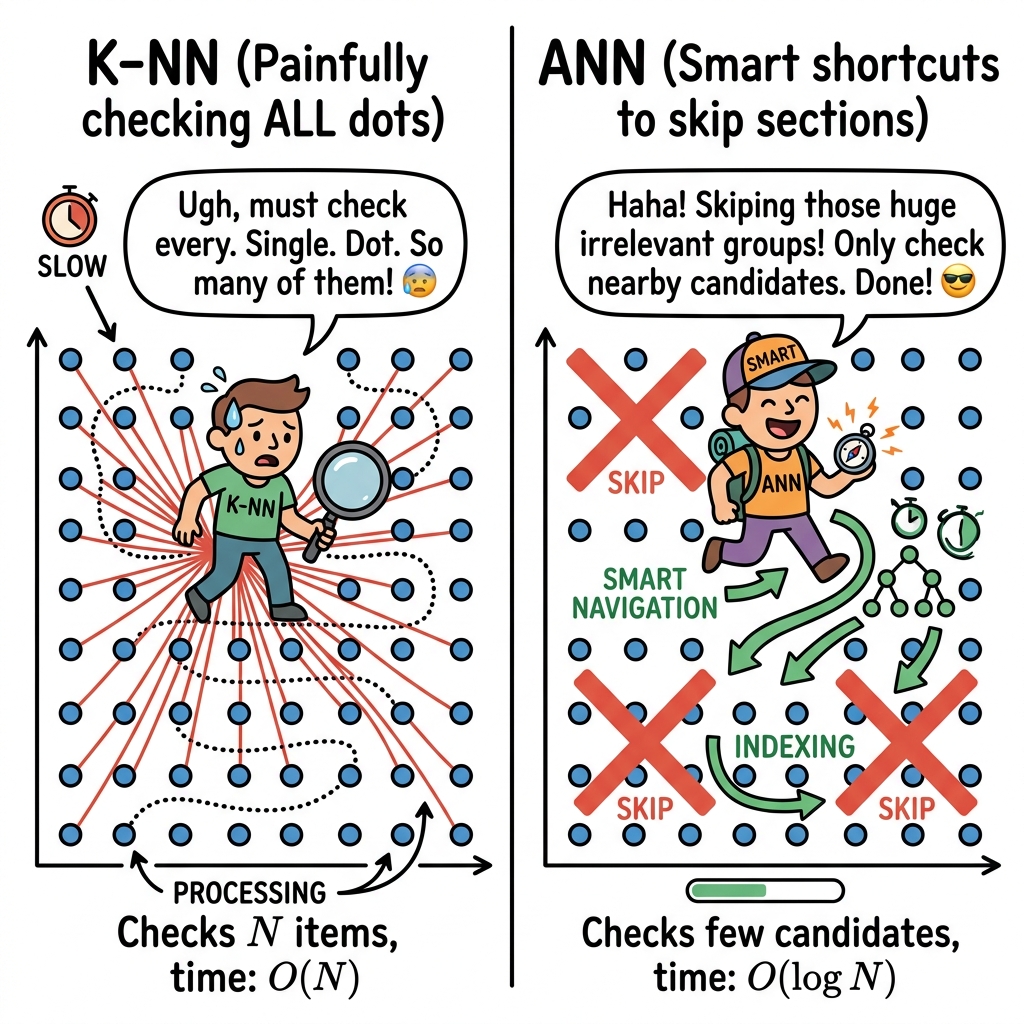
Instead of checking every single vector, ANN uses smart mathematical shortcuts to skip checking 99% of the database. You might accidentally miss the absolute closest mathematical vector, but you will find the 2nd or 3rd closest vector 1,000x faster. For Generative AI, "close enough" is usually perfectly fine!
📌 How ANN Works: Two Popular Algorithms
How does the database skip 99% of the vectors? It uses two main strategies:
1. Clustering (IVF - Inverted File Index)
Before the user ever searches, the database groups the 10 million vectors into physical "neighborhoods" (e.g., the Sports neighborhood, the Finance neighborhood, the Science neighborhood). When the user searches for "Basketball," the database instantly ignores the Finance and Science neighborhoods, and only measures the distances of the vectors living inside the Sports neighborhood.
2. HNSW (Hierarchical Navigable Small World)
This is the current industry-standard algorithm powering almost all major Vector Databases.
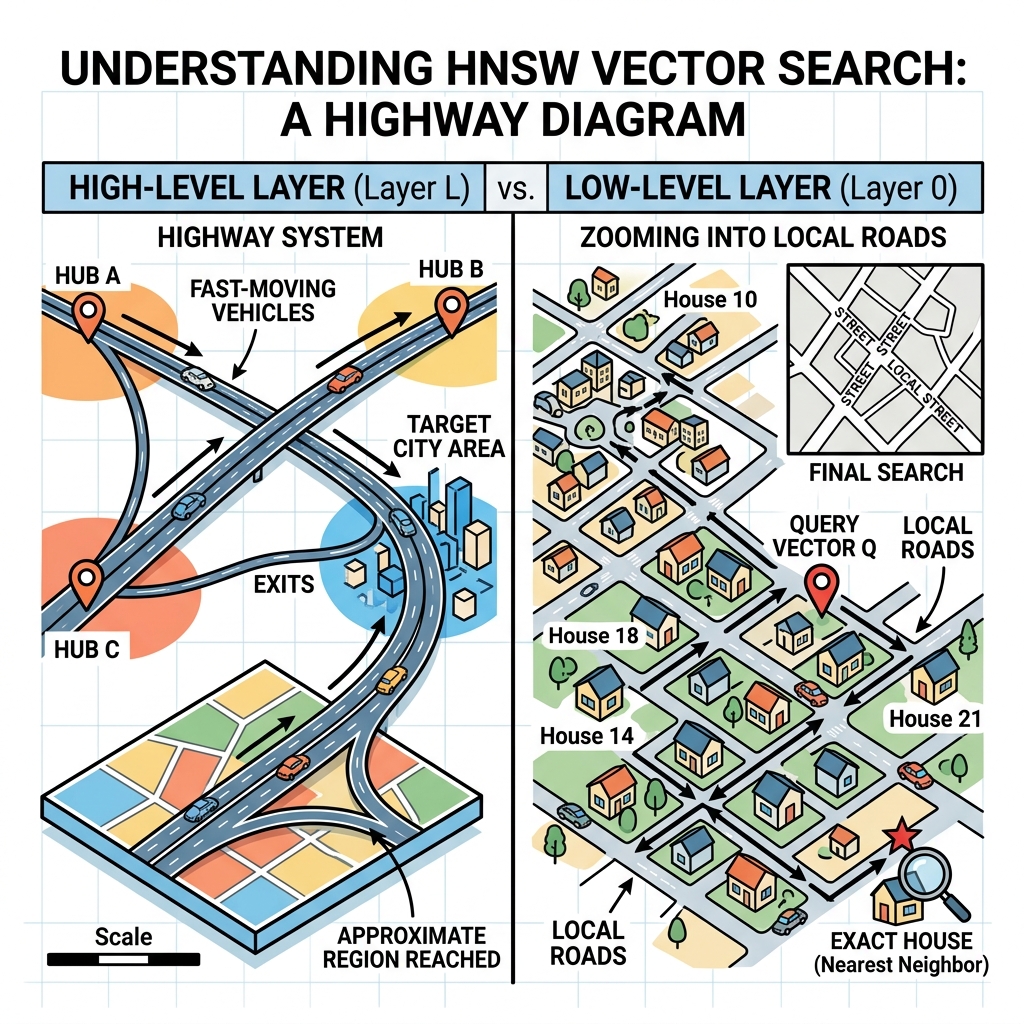
HNSW creates a multi-layered graph that acts exactly like a real-world highway system. The top layer of the graph only contains a few "hub" vectors (the Interstate Highway). It quickly points your search arrow toward the correct general city. As you move down the layers, you get off the highway and onto the local streets, moving node-by-node until you find the exact house (vector) you are looking for. Because you took the highway, you didn't have to drive past every single house in the country!
Quick Knowledge Check
Test what you just learned about Vector Search
Question 1 of 1
Why do modern Vector Databases use ANN (Approximate Nearest Neighbor) algorithms like HNSW, instead of using exact k-NN search?
Loading results...