Vue.js is a progressive JavaScript framework used to build user interfaces and single-page applications. It focuses on being approachable, versatile, and performant.
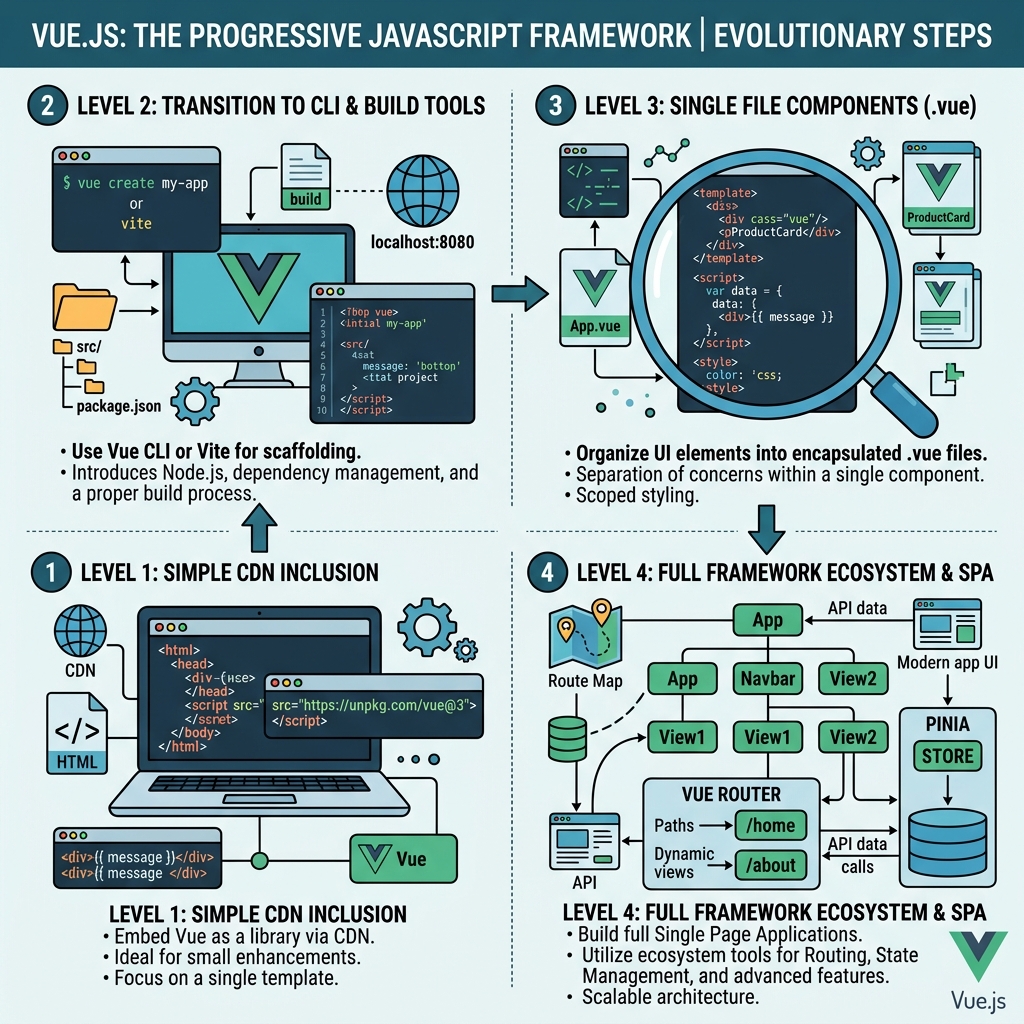
💡 What does "progressive" mean in Vue?
Vue can be integrated incrementally into projects, from enhancing static HTML to powering complex SPAs.
Core Features
- Reactive Data Binding: Automatically syncs data and the DOM with minimal code.
- Declarative Rendering: Use simple template syntax to describe UI structure.
- Component-Based Architecture: Build encapsulated, reusable components.
- Virtual DOM: Efficient updates by minimizing direct DOM manipulations.
- Directives: Special attributes in templates to bind data or respond to events.
| Aspect | Vue | React | Angular |
|---|---|---|---|
| Learning Curve | Gentle | Moderate | Steep |
| Template Syntax | HTML-based | JSX | HTML with Directives |
| State Management | Vuex (official) | Redux/MobX (external) | Built-in |
| Size (minified) | ~20KB | ~40KB | ~150KB |
How Vue Works
Vue uses a reactive data model where changes to data automatically update the DOM. It achieves this by wrapping data objects with getters/setters and using a virtual DOM to optimize rendering.
💡 Vue's Template Syntax
Vue templates look like regular HTML but support special directives such as v-bind, v-if, and v-for to bind attributes, conditionally render elements, or loop over data.
📌 Deep Dive: Simple Vue Template
<div id="app">
  <h1>Hello, {{ name }}!</h1>
  <input v-model="name" placeholder="Enter your name">
</div>
Typical Vue Application Structure
- Root Instance: The main Vue instance controlling a page or component tree.
- Components: Reusable, composable parts with their own templates, scripts, and styles.
- Directives: Built-in or custom instructions to manipulate the DOM.
- Lifecycle Hooks: Functions called at specific stages of a component's existence.
⚠️ Avoid Direct DOM Manipulation
Vue manages DOM updates internally; manipulating DOM elements directly can cause inconsistencies in your interface.
Why Choose Vue?
- Easy to learn and integrate with existing projects
- Great documentation and strong community support
- Flexible: use as a library or a full-fledged framework
- Supports modern tooling and TypeScript
💡 Summary
Vue is a user-friendly, performant framework focused on building reactive interfaces with clear and simple syntax.
Quick Knowledge Check
Test what you just learned
Question 1 of 2
What feature allows Vue to automatically update the DOM when data changes?
Question 2 of 2
Which directive is commonly used in Vue templates to bind input values?
Loading results...