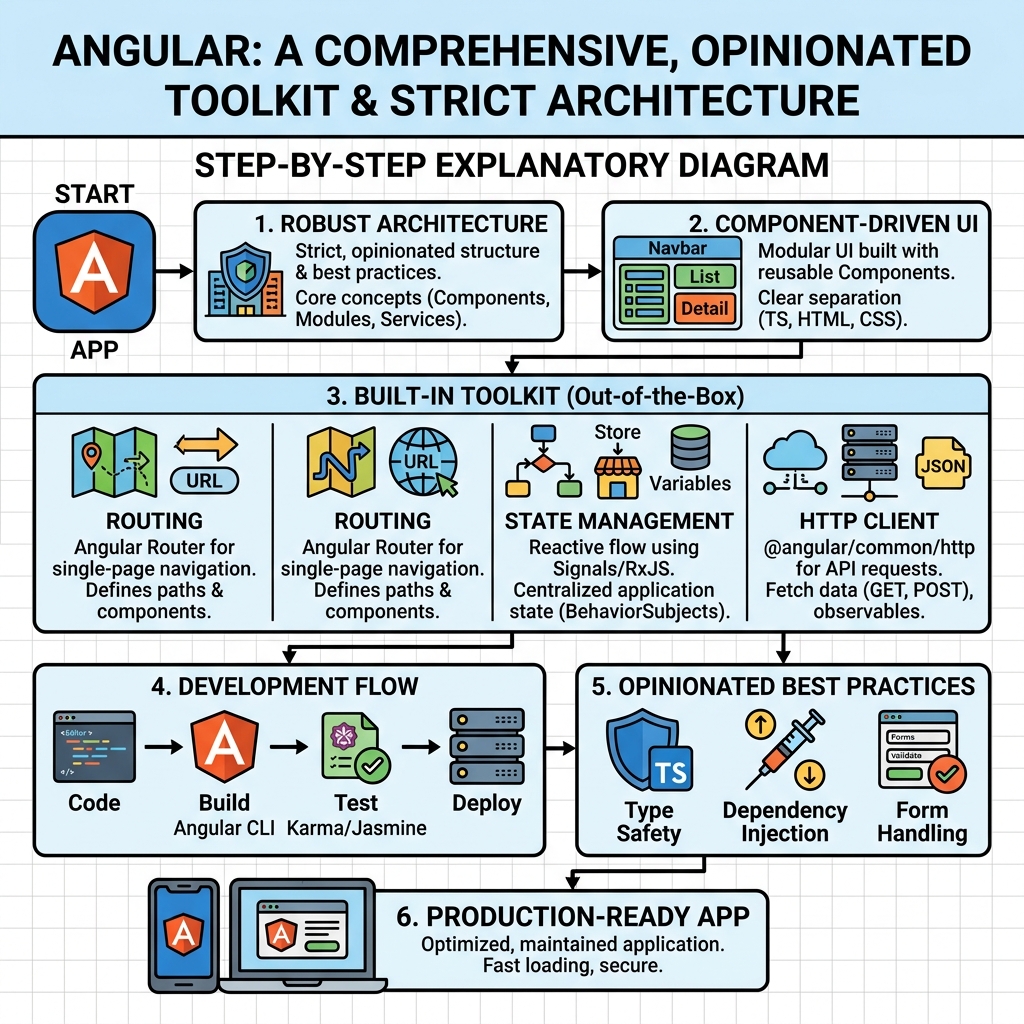
Angular is a popular open-source front-end web application framework developed by Google. It is designed to build dynamic, single-page applications (SPAs) with a modern and maintainable architecture.
💡 Core Concept
Angular uses components and TypeScript to create modular, reusable, and testable code. It follows the Model-View-Controller (MVC) architecture pattern.
Key Features of Angular
- Component-based Architecture: UI built with encapsulated components.
- Two-way Data Binding: Synchronizes data between model and view automatically.
- Dependency Injection: Efficiently manages service and component dependencies.
- Directives: Extend HTML with custom behavior.
- Routing: Manage navigation between different views in a SPA.
- TypeScript Support: Strongly typed language enhancing JavaScript.
- RxJS Integration: Reactive programming with Observables for asynchronous data.
Angular Application Structure
An Angular app typically consists of:
- Modules: Containers for a cohesive block of code (e.g., AppModule).
- Components: Control views and handle user interaction.
- Templates: Define the HTML layout with Angular syntax.
- Services: Provide reusable business logic and data access.
- Routing: Define navigation paths and lazy loading.
| Feature | Angular | React |
|---|---|---|
| Language | TypeScript | JavaScript/JSX |
| Architecture | Full MVC Framework | Library for UI |
| Data Binding | Two-way | One-way |
| Learning Curve | Steeper | Gentler |
| Routing | Built-in | Requires Add-ons |
Basic Angular Component Example
📌 Deep Dive: Simple Component
import { Component } from '@angular/core';

@Component({
  selector: 'app-hello',
  template: '<h1>Hello, Angular!</h1>'
})
export class HelloComponent { }
💡 How It Works
The @Component decorator defines metadata including the HTML tag selector and template. Angular renders this component wherever the selector is used.
⚠️ Important
Angular requires a build process using tools like the Angular CLI to compile TypeScript and templates into browser-compatible JavaScript.
Summary
- Angular is a comprehensive framework ideal for large-scale, maintainable web apps.
- It leverages components, dependency injection, and TypeScript for robust development.
- Built-in features like routing and forms simplify complex application needs.
Quick Knowledge Check
Test what you just learned
Question 1 of 2
What language is Angular primarily built with?
Question 2 of 2
Which feature enables automatic synchronization between the model and the view?
Loading results...