In JavaScript, let, const, and var are used to declare variables, but they behave differently in terms of scope, hoisting, and mutability.
| Feature | var |
let |
const |
|---|---|---|---|
| Scope | Function-scoped | Block-scoped | Block-scoped |
| Hoisting | Hoisted and initialized with undefined |
Hoisted but not initialized (Temporal Dead Zone) | Hoisted but not initialized (Temporal Dead Zone) |
| Reassignment | Allowed | Allowed | Not allowed |
| Redeclaration in same scope | Allowed | Not allowed | Not allowed |
| Use case | Legacy code or function scope variables | Variables that will change | Constants or variables that should not reassign |
💡 Important
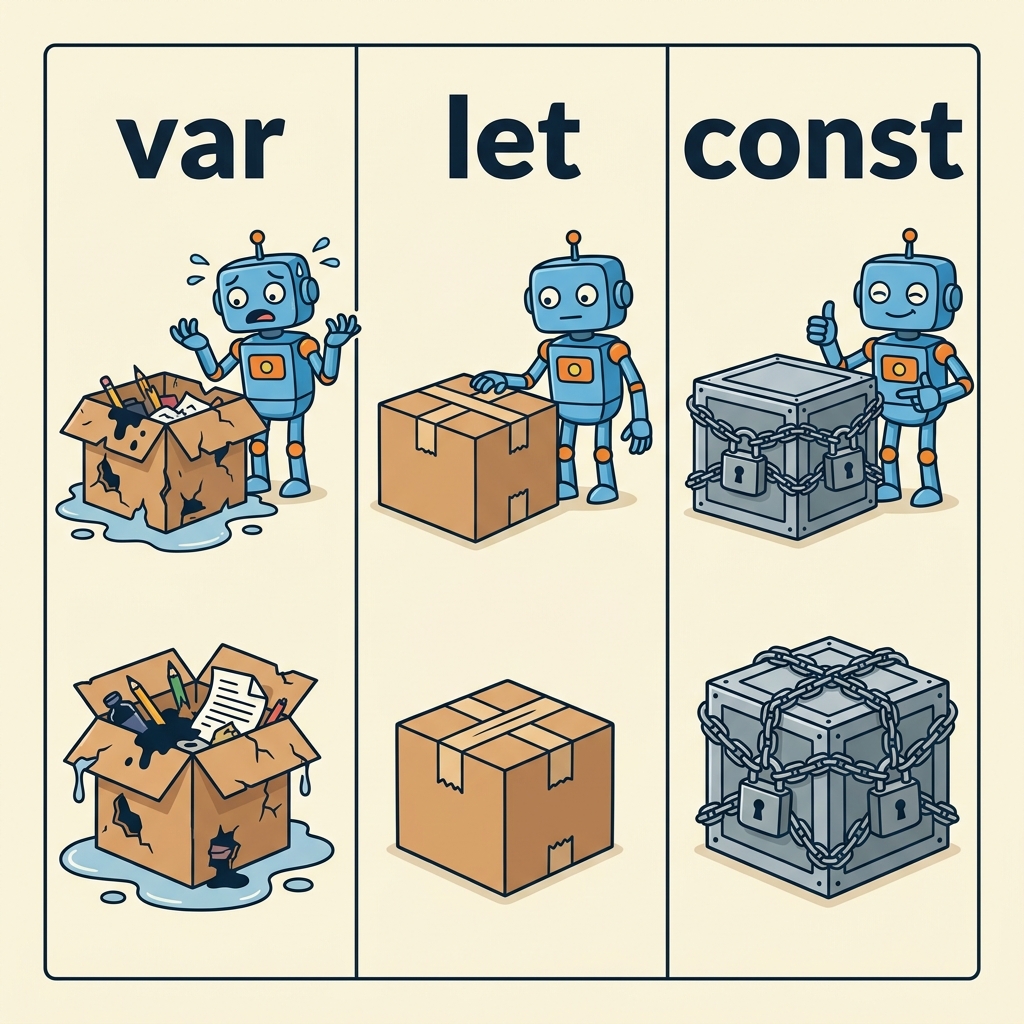
let and const were introduced in ES6 to address issues with var, mainly scoping and accidental redeclarations.
Scope Differences
var is function-scoped, meaning it is accessible throughout the function it is declared in, even before its declaration due to hoisting.
let and const are block-scoped, meaning they are only accessible within the nearest enclosing block (curly braces {}) where they are declared.
📌 Deep Dive: Scope Example
function testScope() {
  if (true) {
    var x = 1;
    let y = 2;
    const z = 3;
  }
  console.log(x); // 1  (function-scoped)
  console.log(y); // ReferenceError: y is not defined
  console.log(z); // ReferenceError: z is not defined
}
testScope();ReferenceError
ReferenceError
Hoisting Behavior
var declarations are hoisted and initialized with undefined, so you can access them before declaration (though it’s not recommended).
let and const are hoisted but not initialized, causing a "Temporal Dead Zone" until their declaration line is executed. Accessing them before declaration throws a ReferenceError.
📌 Deep Dive: Hoisting Example
// var example
console.log(a); // undefined
var a = 10;

// let example
console.log(b); // ReferenceError
let b = 20;

// const example
console.log(c); // ReferenceError
const c = 30;ReferenceError
ReferenceError
Mutability and Reassignment
var and let allow reassignment of the variable value.
const does not allow reassignment after initialization; the variable must be initialized when declared.
Note: const does not make objects or arrays immutable, only the binding cannot be changed.
📌 Deep Dive: Reassignment Example
// var and let reassignment
var x = 1;
x = 2; // allowed

let y = 3;
y = 4; // allowed

// const reassignment
const z = 5;
z = 6; // TypeError: Assignment to constant variable.

// const with objects
const obj = { prop: 1 };
obj.prop = 2; // allowed: object properties can changeTypeError at z = 6
// No error for obj.prop = 2
⚠️ Common Pitfall
Using var can lead to bugs due to unexpected scope and hoisting. Prefer let and const for safer, clearer code.
Quick Knowledge Check
Test what you just learned
Question 1 of 2
Which declaration is block-scoped and does not allow reassignment?
Question 2 of 2
What happens if you try to access a let variable before its declaration?
Loading results...