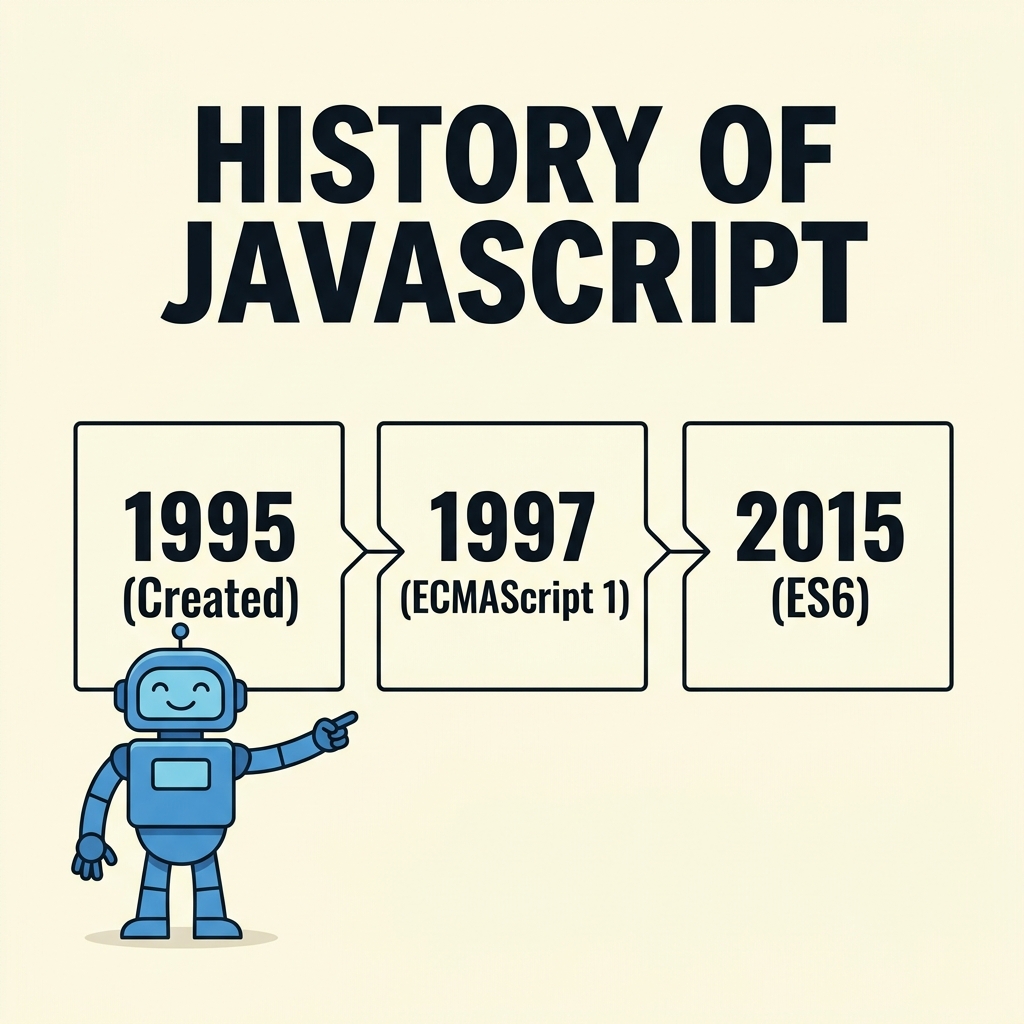
JavaScript was created in 1995 by Brendan Eich at Netscape Communications. Originally developed in just 10 days, its main goal was to add interactivity to web pages.
💡 Key Fact
JavaScript was initially named "Mocha", then "LiveScript", before finally being called "JavaScript".
JavaScript quickly became the standard scripting language for the web and was adopted by other browsers, leading to rapid evolution and new features.
| Year | Event |
|---|---|
| 1995 | JavaScript created by Brendan Eich at Netscape |
| 1996 | JavaScript submitted to ECMA for standardization |
| 1997 | ECMAScript 1 released as the first standard |
| 1999 | ECMAScript 3 introduced many core features |
| 2009 | ECMAScript 5 standardized, adding strict mode and JSON support |
| 2015 | ECMAScript 6 (ES6) brought major syntax improvements |
ECMAScript is the official specification that defines JavaScript, maintained by ECMA International. Every modern JavaScript engine follows this standard.
💡 Why It Matters
JavaScript's rapid growth and continuous improvements have made it the dominant language for client-side web development and beyond.
Modern JavaScript is now used not only in browsers but also on servers, mobile apps, and even desktop applications, showcasing its versatility.
⚠️ Beware of Confusing JavaScript with Java
Despite the name similarity, JavaScript and Java are completely different languages with distinct use cases and syntax.
📌 Deep Dive: Early JavaScript Syntax
function greet(name) {
  return "Hello, " + name + "!";
}
console.log(greet("World"));Quick Knowledge Check
Test what you just learned
Question 1 of 2
Who created JavaScript?
Question 2 of 2
What is the official specification standard for JavaScript?
Loading results...