JavaScript has several fundamental data types. Understanding these basic types and how to annotate them in code helps prevent errors and makes your code easier to read and maintain.
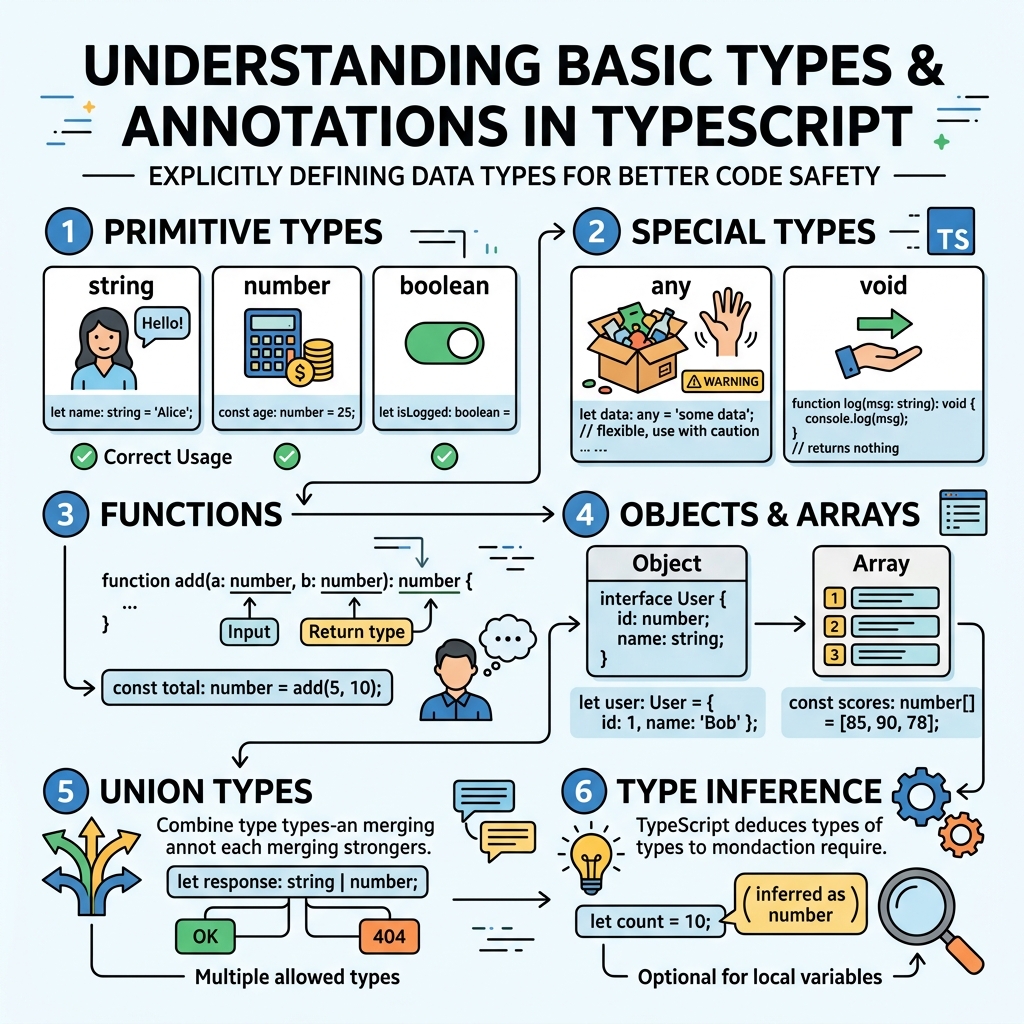
Primitive Types
- Number: Represents both integer and floating-point numbers.
- String: Textual data wrapped in quotes.
- Boolean: Logical true or false values.
- Undefined: Variable declared but not assigned a value.
- Null: Represents an intentional absence of value.
- Symbol: Unique and immutable value, often used as object keys.
- BigInt: For integers larger than the Number type can safely represent.
| Type | Example |
|---|---|
| Number | 42, 3.14 |
| String | 'Hello', "World" |
| Boolean | true, false |
| Undefined | let x; |
| Null | null |
| Symbol | Symbol('id') |
| BigInt | 9007199254740991n |
Type Annotations (with JSDoc)
JavaScript itself is dynamically typed, but you can add type annotations via JSDoc comments to help tools like editors and linters understand your intended types.
📌 Deep Dive: Annotating Variables with JSDoc
/**
 * @type {number}
 */
let age = 30;

/**
 * @type {string}
 */
let name = "Alice";

/**
 * @type {boolean}
 */
let isActive = true;
💡 Why Use Type Annotations?
They improve code readability, enable better editor autocomplete, and help catch type-related bugs before runtime.
Dynamic Typing Notes
JavaScript variables can hold any type, and their type can change at runtime.
📌 Deep Dive: Dynamic Typing Example
let data = 42;      // data is a Number
data = "Hello";      // now data is a String
data = false;        // now data is a Boolean
⚠️ Watch Out for Type Confusion
Changing types can lead to unexpected behavior, especially in comparisons and arithmetic operations.
Summary Table: Type vs. Annotation
| Concept | Description |
|---|---|
| Type | The actual data kind stored in a variable at runtime (e.g., number, string) |
| Annotation | A developer-added comment that states the intended type, used for tooling support |
💡 Remember:
Type annotations do not enforce types at runtime in JavaScript but help developers and tools catch issues early.
Quick Knowledge Check
Test what you just learned
Question 1 of 2
Which JavaScript type represents a true or false value?
Question 2 of 2
What is the primary purpose of type annotations in JavaScript?
Loading results...