In JavaScript, a prototype is an object from which other objects inherit properties and methods. It is the mechanism that enables inheritance and shared behavior across objects.
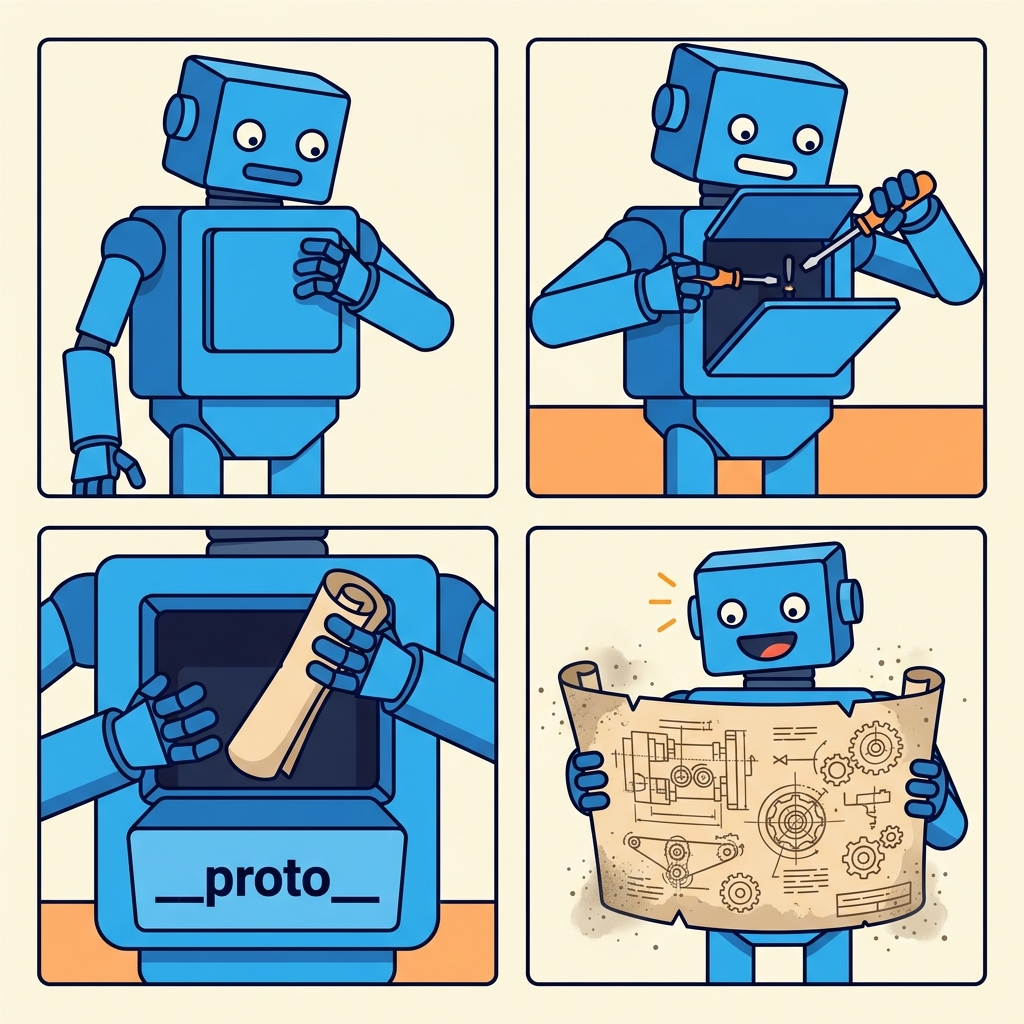
💡 Prototype Basics
Every JavaScript object has an internal link to another object called its prototype. When you access a property or method on an object, JavaScript looks for it on the object itself, and if not found, it follows the prototype chain upwards to find it.
This prototype chain is what makes JavaScript objects dynamic and allows methods to be shared efficiently.
| Object | Prototype |
|---|---|
| An instance with its own properties | A shared object linked to instances |
| Holds own data | Holds shared methods or properties |
| Accessed directly | Accessed via internal [[Prototype]] link |
💡 Prototype Chain
If a property or method is not found on the object itself, JavaScript looks up the prototype chain until it either finds the property or reaches the end (null).
📌 Deep Dive: Accessing Properties via Prototype
const animal = {
  eats: true,
  walk() {
    return "Animal walks";
  }
};

const rabbit = Object.create(animal);
rabbit.jumps = true;

console.log(rabbit.eats);  // true (inherited from animal)
console.log(rabbit.walk()); // "Animal walks" (inherited method)
console.log(rabbit.jumps); // true (own property)"Animal walks"
true
In this example, rabbit inherits properties and methods from animal through the prototype.
⚠️ Important
The prototype itself is an object, so it can have its own prototype, forming a chain. The chain ends at null, which has no prototype.
💡 Prototype in Functions
Functions in JavaScript have a prototype property used when creating new objects via the new keyword. The created object's internal prototype points to the function's prototype object.
Quick Knowledge Check
Test what you just learned
Question 1 of 2
What happens when you access a property on an object that it does not have?
Question 2 of 2
What is the prototype of the object created by Object.create(protoObj)?
Loading results...