Imagine trying to solve a puzzle where the solution requires solving smaller versions of the same puzzle first. This self-referential approach is what recursion is all about in programming. It’s a powerful technique where a function calls itself to break a complex problem into simpler, more manageable parts until reaching a basic case that can be solved directly.
Recursion can initially seem abstract or even confusing, but once you grasp its flow, it becomes an indispensable tool for tackling problems involving repetitive structures, such as tree traversals, factorial calculations, and many algorithmic challenges.
What is Recursion?
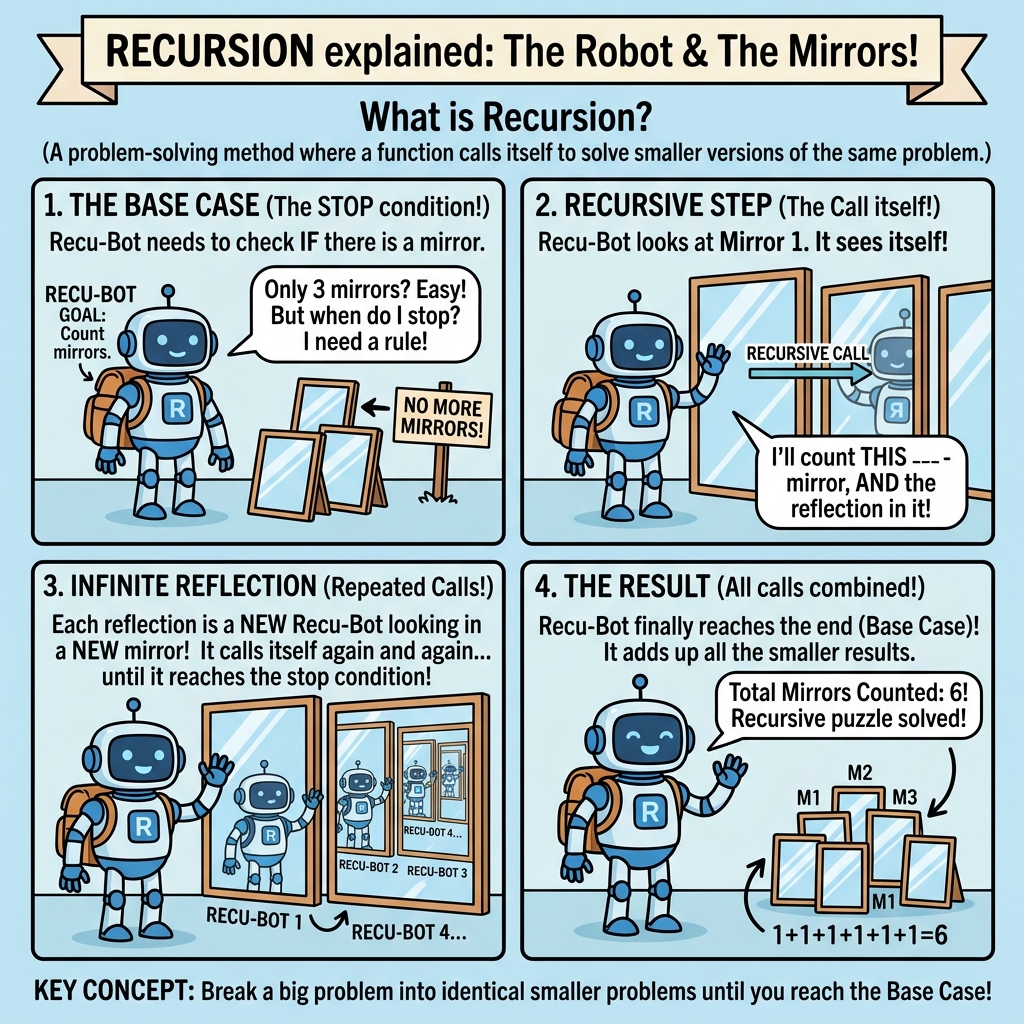
At its core, recursion is a method where a function solves a problem by calling itself with a simpler or smaller input. This self-call continues until the function encounters a base case — a condition that stops the recursion.
Think of it like a set of nested Russian dolls: to open the largest doll, you need to open the smaller one inside it, which requires opening an even smaller one, and so on, until you reach the tiniest doll that can be opened directly without any further action.
💡 Key Concept: Base Case
The base case is essential in recursion. It prevents infinite loops by defining a condition where the function stops calling itself. Without a proper base case, recursion will continue indefinitely, eventually causing a program crash.
How Does Recursion Work in Python?
In Python, defining a recursive function follows the same syntax as any other function, but inside its body, it calls itself with modified arguments. Let’s explore the structure:
- Recursive Case: The part where the function calls itself with a smaller input.
- Base Case: The simple condition where the recursion ends.
Here’s a generalized template:
📌 Deep Dive: Basic Recursive Function Structure
def recursive_function(parameters):
    if base_case_condition(parameters):
        return base_case_value
    else:
        return recursive_function(modified_parameters)
To solidify this, let’s dive into a classic example: calculating the factorial of a number.
Example: Calculating Factorial Using Recursion
The factorial of a positive integer n (denoted as n!) is the product of all positive integers less than or equal to n. For example, 5! = 5 × 4 × 3 × 2 × 1 = 120.
The factorial function naturally fits recursion because:
- Factorial of 1 is 1 (our base case).
- Factorial of
nisn × factorial(n-1)(recursive case).
📌 Deep Dive: Factorial Function
def factorial(n):
    # Base case: factorial of 1 is 1
    if n == 1:
        return 1
    else:
        # Recursive case: n * factorial of (n-1)
        return n * factorial(n - 1)

print(factorial(5)) # Output: 120In this function:
- If
nequals 1, the function returns 1, stopping the recursion. - Otherwise, it calls itself with
n - 1and multiplies the result byn.
This recursive call chain continues until it reaches the base case, then the results unravel back up the chain, ultimately delivering the final factorial value.
Tracing the Execution Flow
Understanding how recursion unfolds can be tricky. Let’s trace factorial(3) step-by-step:
factorial(3)calls3 * factorial(2)factorial(2)calls2 * factorial(1)factorial(1)hits the base case and returns 1- Now,
factorial(2)returns2 * 1 = 2 - Finally,
factorial(3)returns3 * 2 = 6
💡 Recursive Call Stack
Each recursive call is placed on the call stack, a structure that keeps track of active functions. When the base case is reached, the stack starts to unwind, returning values back up the chain.
When to Use Recursion?
Recursion shines when dealing with:
- Divide-and-conquer algorithms: Problems broken into subproblems, like sorting (merge sort, quicksort).
- Tree or graph traversals: Navigating hierarchical or network structures.
- Mathematical sequences: Fibonacci numbers, factorials, combinatorial problems.
However, recursion is not always the best tool. Sometimes, an iterative approach (using loops) is more efficient and easier to understand.
⚠️ Beware of Excessive Recursion Depth
Python limits the maximum recursion depth (usually around 1000) to prevent infinite recursion from crashing your program. If your recursive calls exceed this limit, you'll get a RecursionError. Make sure your base case is reachable, and be mindful of input sizes.
Example: Fibonacci Sequence
The Fibonacci sequence is a famous example where each number is the sum of the two preceding ones:
0, 1, 1, 2, 3, 5, 8, 13, 21, ...
The recursive definition:
fib(0) = 0(base case)fib(1) = 1(base case)fib(n) = fib(n-1) + fib(n-2)(recursive case)
📌 Deep Dive: Recursive Fibonacci Function
def fib(n):
    if n == 0:
        return 0
    elif n == 1:
        return 1
    else:
        return fib(n - 1) + fib(n - 2)

print(fib(7)) # Output: 13While this implementation is straightforward, it’s not efficient for large n due to repeated calculations. Optimizations such as memoization or iterative methods can enhance performance.
Comparing Recursion and Iteration
Both recursion and iteration can solve many problems, but they have different characteristics.
| Aspect | Recursion | Iteration |
|---|---|---|
| Definition | Function calls itself | Repeated execution using loops |
| Use Case | Good for hierarchical problems (trees, divide & conquer) | Good for sequential repetitive tasks |
| Memory | Uses call stack, can be memory-intensive | Memory efficient, uses loop constructs |
| Complexity | Can be easier to understand for some problems | Sometimes more complex for nested structures |
| Performance | May be slower due to call overhead | Generally faster due to fewer overheads |
| Risk | Possible stack overflow if base case missing | No risk of stack overflow |
Tips for Writing Recursive Functions in Python
- Always define a clear base case. Without it, your program will crash.
- Make sure each recursive call moves closer to the base case. This ensures the recursion will eventually stop.
- Keep your function simple and focused. Complex recursion can be hard to debug.
- Test with small inputs first. This helps verify the correctness of your recursion logic.
- Consider iterative alternatives if recursion depth is an issue.
💡 Debugging Recursion
Recursion can sometimes be confusing to debug. Try adding print statements to track function calls and returns, or use debugging tools to step through each recursive call.
Advanced: Tail Recursion and Python
In some languages, tail recursion — where the recursive call is the last operation in the function — can be optimized by compilers to prevent growing the call stack. However, Python does not optimize tail recursion, so deep recursion can still cause stack overflow.
For example, this tail-recursive style:
📌 Deep Dive: Tail Recursive Factorial
def tail_factorial(n, accumulator=1):
    if n == 1:
        return accumulator
    else:
        return tail_factorial(n - 1, accumulator * n)

print(tail_factorial(5)) # Output: 120In Python, this won’t save stack space, but it’s a useful pattern conceptually.
Summary
Recursion is an elegant programming technique where a function solves a problem by calling itself with simpler inputs. The key to successful recursion is a well-defined base case that stops the repetition. Problems like factorials, Fibonacci sequences, and navigating hierarchical data structures are natural fits for recursion.
While powerful, recursion must be used carefully to avoid performance issues or exceeding recursion limits. Understanding when to use recursion and how to structure it properly will greatly enhance your Python problem-solving toolkit.
Quick Knowledge Check
Test what you just learned
Question 1 of 2
What is the purpose of the base case in a recursive function?
Question 2 of 2
Which of the following problems is a natural fit for recursion?
Loading results...