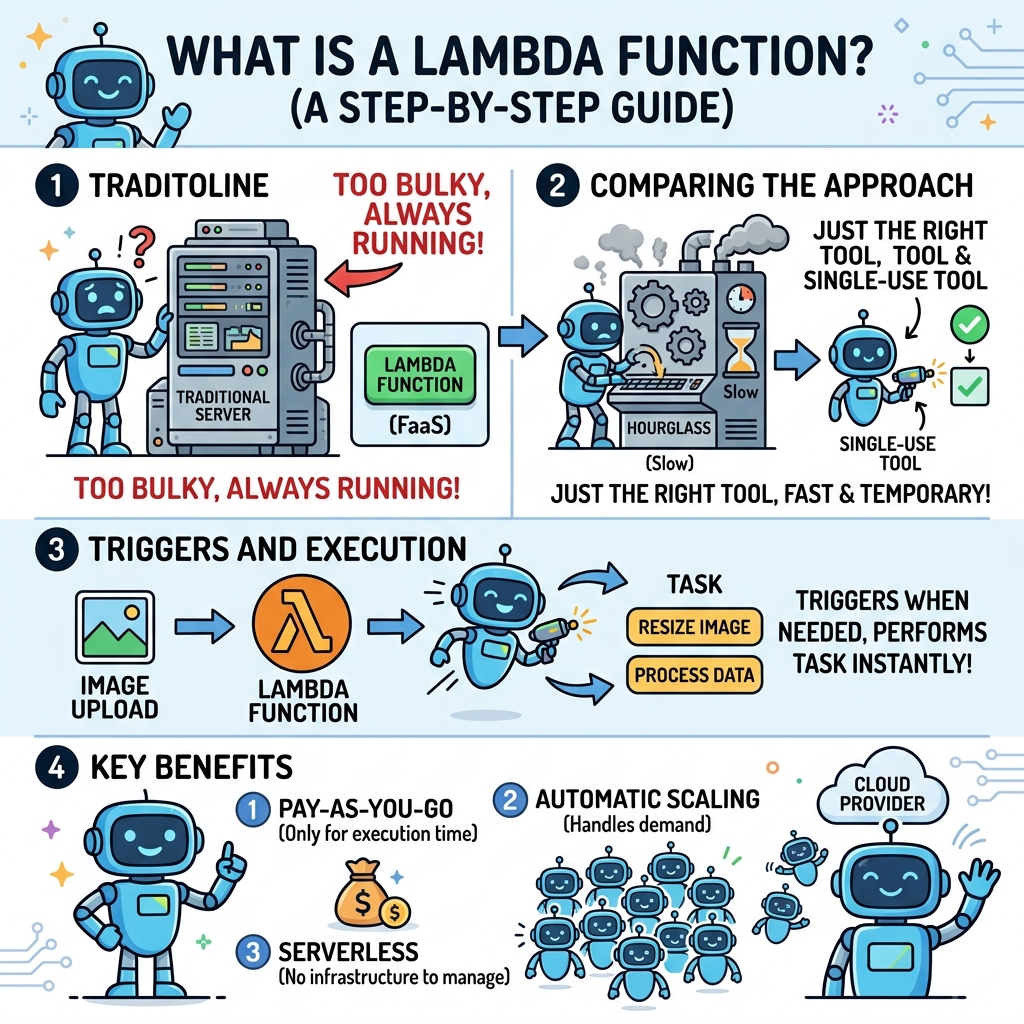
When writing Python code, you often need simple functions to perform basic operations. While the def keyword is the traditional way to define functions, Python offers a more concise and flexible alternative: lambda functions. These are anonymous, inline functions that can be defined in a single line without a formal name. Lambda functions are perfect for short, throwaway functions, especially when used as arguments to higher-order functions like map(), filter(), or sorted().
In this lesson, you will gain a deep, practical understanding of lambda functions, learning how to use, write, and apply them effectively in your Python projects.
What Are Lambda Functions?
A lambda function is an anonymous function expressed as a single statement. Unlike regular functions defined with def, lambda functions do not have a name (unless you assign them to a variable) and are generally used for simple operations.
The basic syntax of a lambda function is:
lambda arguments: expression
Here:
arguments are the inputs to the function (like parameters)
expression is a single expression evaluated and returned automatically
Lambda functions can take any number of arguments but only contain one expression, whose result is returned.
💡 Key Point
Lambda functions are not meant to replace all functions but are ideal for short, simple operations where defining a full function might feel verbose.
Writing Your First Lambda Function
Let's start by defining a simple lambda function that adds 10 to a given number:
📌 Deep Dive: Simple Addition
PYTHON
add_ten = lambda x: x + 10
print(add_ten(5))
Output
15
Here, lambda x: x + 10 creates an anonymous function that takes one argument x and returns x + 10. We assign it to the variable add_ten so we can call it later.
How Are Lambda Functions Different from Regular Functions?
To clarify the differences, consider the following comparison:
Lambda vs Regular Functions
Aspect
Lambda Function
Regular Function (def)
Syntax
Single line, anonymous lambda args: expression
Multiple lines, named def func(args): ...
Return
Implicit (expression value)
Explicit (using return)
Complexity
Limited to one expression
Can have multiple statements
Use case
Short, throwaway functions
Reusable and complex functions
Using Lambda Functions with Built-in Functions
Lambda functions become extremely powerful when combined with Python's built-in higher-order functions. Let's explore the most common scenarios.
Using map() to Transform Lists
map() applies a function to all items in an iterable and returns a map object (which can be converted to a list).
Since 'banana' ends with 'a', 'apple' with 'e', and 'cherry' with 'y', the list is sorted by these last letters alphabetically.
When to Use Lambda Functions?
Lambda functions shine when:
You need a small function for a short period.
You want to keep your code compact and readable.
You are passing functions as arguments to other functions.
You prefer not to clutter your namespace with one-off function names.
However, for complex logic or if the function is reused multiple times, a regular function defined with def is usually better.
⚠️ Caution
Avoid writing complicated lambda functions with nested expressions. It can make your code harder to read and maintain. When in doubt, use a named def function instead.
Lambda Functions with Multiple Arguments
Lambda functions can accept multiple arguments, just like regular functions. The only limitation remains that the function body must be a single expression.
📌 Deep Dive: Multiplying Two Numbers
PYTHON
multiply = lambda x, y: x * y
print(multiply(4, 5))
Output
20
Using Lambda with Data Structures
Lambda functions are frequently used with data structures like lists of tuples or dictionaries, especially for sorting or transforming data.
📌 Deep Dive: Sorting a List of Tuples by Second Element