When learning Python loops, you've probably seen for and while loops in action. But did you know that both these loops can have an else clause? The loop else clause is a unique and often misunderstood feature in Python that can make your code more expressive and clear when used properly.
In this comprehensive lesson, we’ll explore what the loop else clause is, how it works, when to use it, and practical examples that clarify its real-world usage. By the end, you’ll be confident in leveraging this Python feature to write cleaner and more efficient loops.
Unpacking the Loop Else Clause: What Is It?
At first glance, it might seem unusual that a loop, which typically repeats code multiple times, has an else attached. Unlike an if-else statement, the else in loops does not run after every iteration. Instead, it runs only once:
- After the loop completes all its iterations naturally, without being interrupted by a
breakstatement. - It does not run if the loop is terminated early by a
break.
Think of the loop else as a confirmation that the loop ran "to completion" without getting cut short.
💡 Key Insight
The else clause after a loop is like a “no interruptions” signal—it executes only if the loop wasn’t broken out of early.
How Does It Work? Breaking Down the Control Flow
Here’s the typical control flow of a loop with an else:
- The loop starts and runs its block repeatedly.
- If a
breakstatement is encountered during any iteration, the loop immediately exits, skipping theelseblock. - If the loop finishes all iterations without a
break, theelseblock executes once.
This behavior applies to both for and while loops.
Visualizing the Loop Else Flow
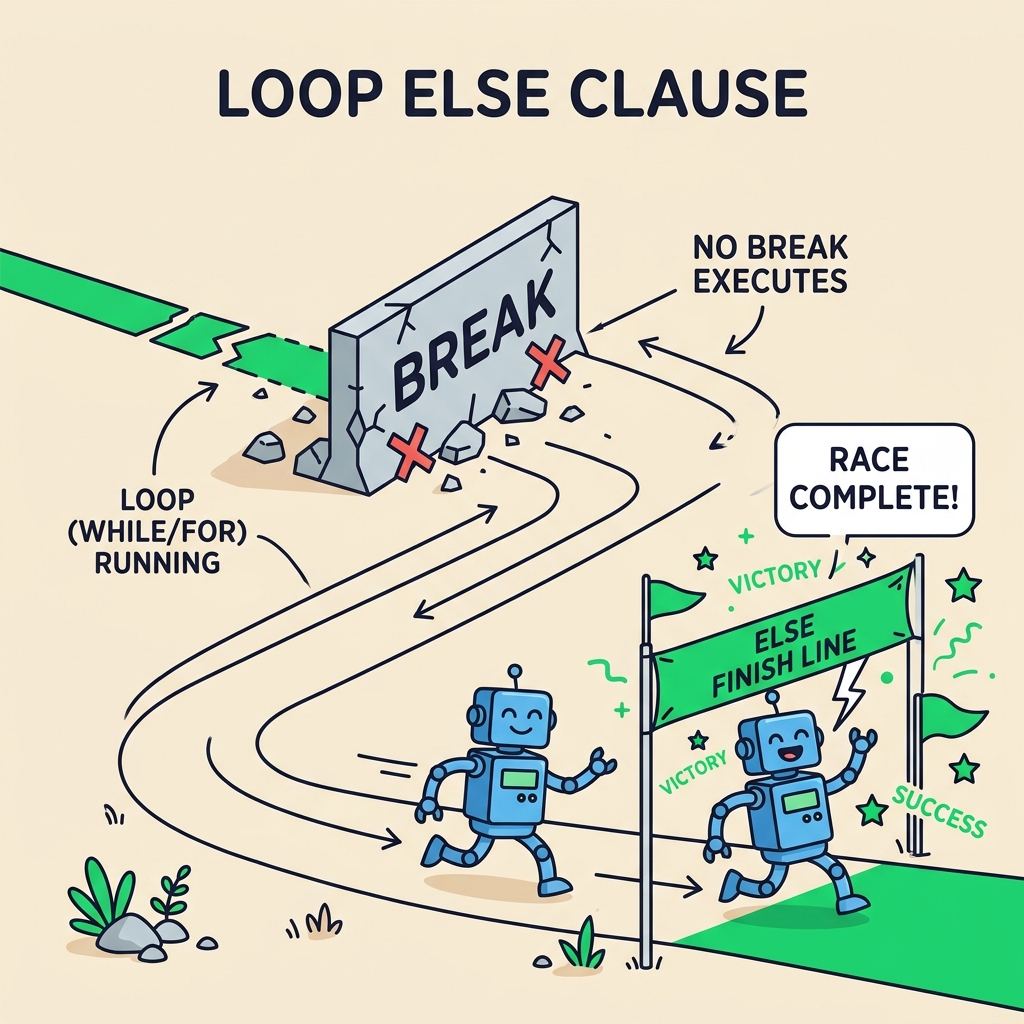
Example 1: Using For Loop with Else
Imagine you want to search for a number in a list. If the number is found, you want to stop searching immediately. If the number is not found after checking all elements, you want to notify the user.
📌 Deep Dive: For Loop with Else
numbers = [10, 20, 30, 40, 50]
target = 25

for num in numbers:
    if num == target:
        print(f"Found {target} in the list!")
        break
else:
print(f"{target} is not in the list.")What’s happening here?
- The
forloop checks each number against the target. - If it finds a match, it prints a message and
breaks out of the loop. - If the loop finishes without finding the target, the
elseblock runs, printing the “not found” message.
Example 2: While Loop with Else
Using a while loop, let's try a countdown that stops early if a condition is met:
📌 Deep Dive: While Loop with Else
count = 5

while count > 0:
    print(f"Counting down: {count}")
    if count == 3:
        print("Early stop triggered!")
        break
    count -= 1
else:
print("Countdown completed!")Notice that the else block did not execute because the loop was interrupted by the break.
When to Use Loop Else Clause: Practical Scenarios
The loop else clause is most useful when you want to:
- Search for something and handle the “not found” case elegantly.
- Execute clean-up or confirmation code only if the loop ran fully.
- Avoid using additional flags or variables to track loop completion.
Without the loop else, you might write code like this:
📌 Deep Dive: Without Loop Else
found = False
for item in collection:
    if condition(item):
        found = True
        break

if not found:
    # handle not found case
With the loop else, this becomes more streamlined:
📌 Deep Dive: With Loop Else
for item in collection:
    if condition(item):
        break
else:
    # handle not found case
💡 Why prefer the loop else?
It reduces the need for extra variables, making your code more readable and idiomatic Python.
Loop Else Clause vs If-Else: Clarifying the Difference
It’s common to confuse the loop else clause with the if-else construct. Here’s a clear comparison:
| Aspect | Loop Else Clause |
|---|---|
| Used With | for or while loops |
| Execution Condition | Runs only if loop completes without break |
| Purpose | Handles the “no break” situation in loops |
| Number of Executions | At most once, after loop |
In contrast, an if-else chooses between two paths based on a condition immediately, unrelated to looping.
Common Pitfalls and How to Avoid Them
- Misunderstanding when
elseruns: Remember it only runs if the loop wasn’t interrupted bybreak. - Using
elsewithoutbreak: If your loop never usesbreak, theelsewill always execute after the loop. This might not always be what you want. - Confusing loop else with else in try-except: Although similar in concept, they serve different purposes.
⚠️ Warning
Don’t use loop else to execute code after every loop iteration. It runs only once after the loop finishes normally.
Advanced Example: Prime Number Check Using Loop Else
One of the classic uses of the loop else clause is to check if a number is prime:
📌 Deep Dive: Prime Number Check with Loop Else
num = 29

if num < 2:
    print(f"{num} is not prime.")
else:
    for i in range(2, int(num ** 0.5) + 1):
        if num % i == 0:
            print(f"{num} is not prime; divisible by {i}.")
            break
    else:
print(f"{num} is prime!")Here’s why this works so well:
- The loop attempts to find a divisor.
- If a divisor is found, it prints the number is not prime and breaks.
- If no divisors are found (loop completes normally), the
elseblock confirms the number is prime.
Summary: Mastering Loop Else Clause
Let’s recap the key takeaways:
- The
elseclause on loops executes only when the loop completes without hitting abreak. - It works with both
forandwhileloops. - Great for search patterns where you want to detect “not found” cases elegantly.
- Helps avoid extra flags or complicated logic after loops.
- Commonly used in algorithms like prime checking or validation loops.
Understanding and using the loop else clause can elevate your Python loops from basic iteration to expressive and idiomatic code. Experiment with it in your own projects to get comfortable and discover where it fits best.
💡 Final Tip
When reading or writing Python code, spotting a loop with an else clause is a hint that the program’s logic depends on whether the loop was interrupted or ran fully—keep this in mind to understand the flow better.
Quick Knowledge Check
Test what you just learned
Question 1 of 2
When does the else block in a Python loop execute?
Question 2 of 2
Which of the following is a good use case for a loop else clause?
Loading results...