Python is one of the most popular and versatile programming languages in the world today. But understanding its history not only helps us appreciate its design philosophy but also provides insights into how it evolved to become the language beloved by millions of developers globally. This lesson explores the origins of Python, its creator, key milestones, and how Python’s development was influenced by other programming languages and needs of the era.
Developed in the late 1980s, Python was designed to emphasize code readability, simplicity, and extensibility. Unlike many other languages of its time, it adopted a clean syntax and intuitive structure that allowed both novices and experts to write powerful code efficiently. From its humble beginnings to becoming the backbone of modern web development, data science, artificial intelligence, and automation, Python’s history is a journey of innovation and community collaboration.
💡 A Simple Analogy: Python as a Language Family Tree
Think of programming languages like members of a family tree. Just as children inherit traits from their parents, programming languages evolve by building upon the strengths and ideas of their predecessors. Python is like a child who learned from multiple languages such as ABC, Modula-3, and C, taking the best features from each to create a versatile and user-friendly language.
The Beginning: Guido van Rossum and the Birth of Python In December 1989, Guido van Rossum, a Dutch programmer working at Centrum Wiskunde & Informatica (CWI) in the Netherlands, started developing Python as a successor to the ABC language, aiming to fix some of ABC’s limitations while preserving its strengths.
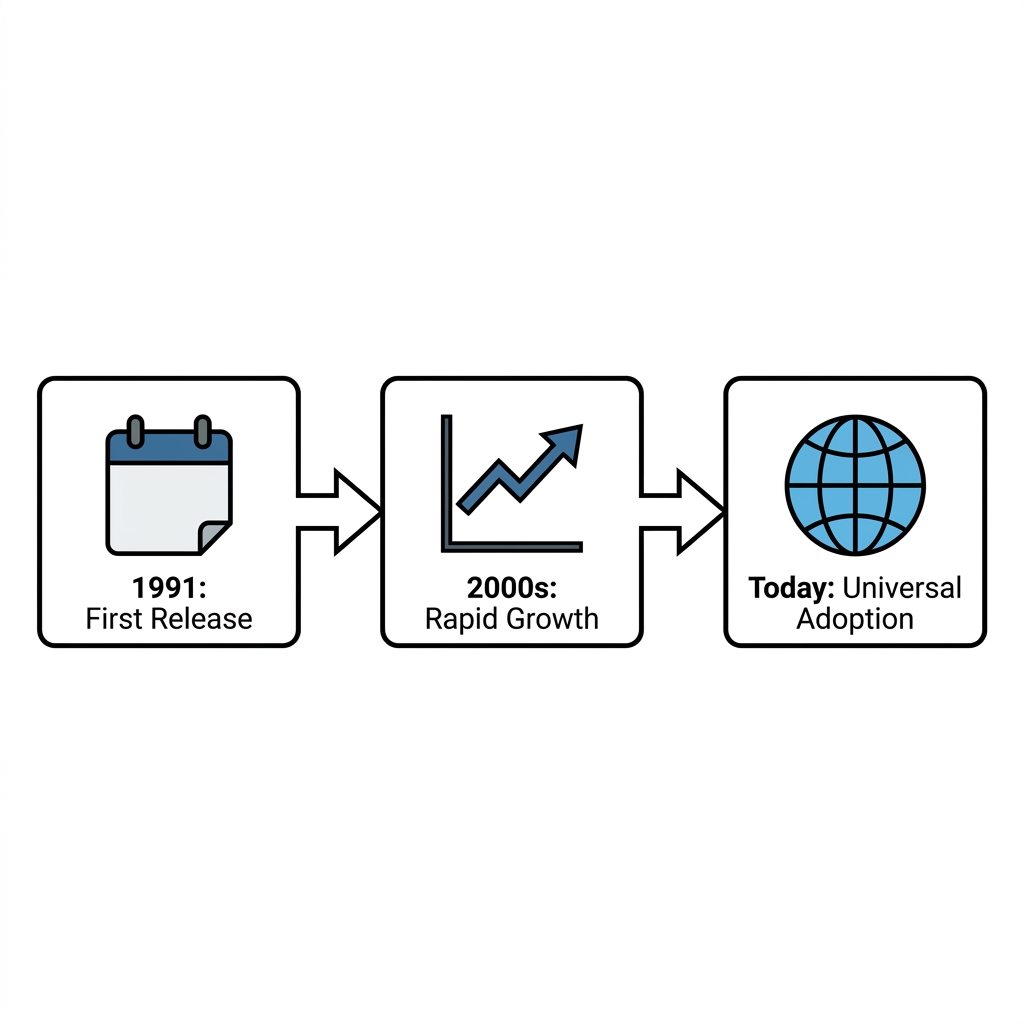
Python 1.0 Released in 1991 Python’s first public release was in February 1991. This version introduced many core features such as exception handling, functions, and modules, setting the foundation for Python’s future growth.
Python 2.x Series: Growing Popularity and New Features Released in 2000, Python 2 introduced list comprehensions, garbage collection, and many standard library improvements. It was widely adopted but eventually phased out to make way for a cleaner Python 3.
Python 3.x: A Clean Break and Modernization Launched in 2008, Python 3 fixed long-standing design flaws, improved Unicode support, and cleaned up the language syntax. Despite initial resistance due to backward incompatibility, Python 3 is now the present and future of the language.
Community-Driven Evolution Python’s growth has been fueled by a vibrant community contributing to its development, creating libraries, frameworks, and documentation, making it an accessible language for diverse applications.
🛠️ Real-World Use Case: Python’s Role in Web and Data Science
By understanding Python’s history, developers can appreciate how its design favors readability and extensibility, which is why it became the preferred language for web frameworks like Django and Flask, as well as data science libraries like NumPy, pandas, and TensorFlow. These applications highlight Python’s adaptability and how its historical decisions impact modern software development.
⚠️ Common Pitfall: Confusing Python 2 and Python 3 Syntax
When learning Python, beginners sometimes try running Python 2 code in Python 3 environments or vice versa. For example, the print statement in Python 2 (print "Hello") becomes a print function in Python 3 (print("Hello")). This difference can cause syntax errors and confusion, so it's important to know which Python version you are working with.
# Python 3 print function
print("Hello, Python 3!")
📌 Deep Dive: Python’s Guiding Philosophy — The Zen of Python
import this

# This command prints "The Zen of Python," a collection of aphorisms
# that capture the philosophy behind Python's design.
Quick Knowledge Check
Test what you just learned
Question 1 of 2
Who is the creator of the Python programming language?
Question 2 of 2
What was a major reason for developing Python 3?
Loading results...