When writing Python programs, errors and exceptions often occur — that's just a fact of life in software development. But sometimes, an error happens because another error happened first. Understanding how these errors relate can be critical for effective debugging and creating robust applications. This is where exception chaining comes into play.
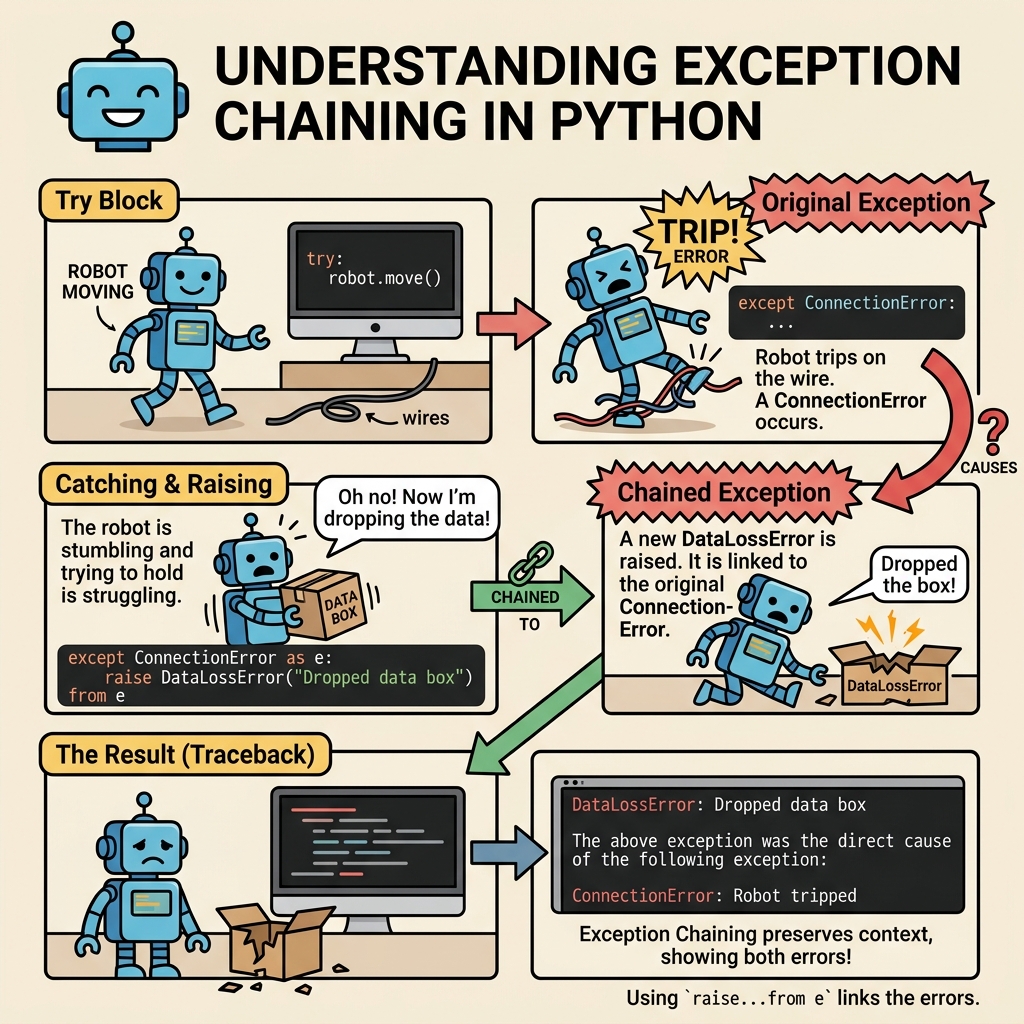
Exception chaining allows you to connect a newly raised exception to an original exception, preserving the context and tracebacks of both. This feature helps you understand the root cause of errors while handling exceptions gracefully.
Why Is Exception Chaining Important?
Imagine you have a function that processes user input and then saves data to a database. If the database connection fails, you might want to raise a custom exception to indicate a "Data Saving Error." However, the original failure might be a network timeout or authentication error. Exception chaining preserves this original error while letting you provide a more meaningful or higher-level exception message.
Without chaining, you'd lose the original context, making debugging difficult. With it, Python automatically links the original error to the new one, offering a complete picture.
💡 Key Insight
Think of exception chaining like a relay race baton: the original exception hands off its context to the new exception, so the full story is carried forward.
How Does Python Support Exception Chaining?
Python supports exception chaining primarily through two mechanisms:
- Implicit chaining — happens automatically when an exception is raised inside an
exceptblock. - Explicit chaining — done manually using the
raise ... from ...syntax to link exceptions.
Let's explore both in detail.
Implicit Chaining
When an exception occurs inside an except block while you are handling another exception, Python automatically chains them. The original exception becomes the cause of the new exception, and this relationship is reflected in the traceback.
📌 Deep Dive: Implicit Exception Chaining
try:
    x = int("not-a-number")  # Raises ValueError
except ValueError:
    # Handling but raising a new exception inside
raise RuntimeError("Failed during conversion")Notice in the output that Python reports both exceptions — the original ValueError and the new RuntimeError. This automatic linking helps you trace back the error's origin.
Explicit Chaining Using raise ... from ...
Python allows you to explicitly specify the cause of an exception using raise NewException(...) from OriginalException. This makes it clear that the new exception is directly caused by the original one.
📌 Deep Dive: Explicit Exception Chaining
try:
    data = open('missing_file.txt').read()
except FileNotFoundError as e:
raise RuntimeError("Could not load data") from eExplicit chaining is often preferred because it documents the exact cause and intent clearly in your code.
💡 Pro Tip
Use explicit chaining raise ... from ... when you want to translate a low-level error into a higher-level one but still keep the original context.
Suppressing Exception Chaining
Sometimes, you might want to raise a new exception without preserving the original context. Python lets you do this by setting the cause explicitly to None with raise ... from None. This suppresses the chaining and prints only the new exception.
📌 Deep Dive: Suppressing Exception Chaining
try:
    1 / 0
except ZeroDivisionError:
raise ValueError("Invalid operation") from NoneHere, the original ZeroDivisionError is hidden, and only the ValueError is shown.
⚠️ Warning
Suppressing exception chaining using from None should be done cautiously, as it removes valuable debugging information about the root cause.
Understanding the Attributes: __cause__ and __context__
When Python chains exceptions, it sets two special attributes on the new exception object:
__cause__: Set when you explicitly useraise ... from .... It points to the original exception.__context__: Set when an exception is raised while handling another, but without explicit chaining.
These attributes help Python build the full traceback and allow advanced exception handling if needed.
| Attribute | When Set | Description |
|---|---|---|
__cause__ | Explicit chaining (raise ... from ...) | Points to the original exception causing the new one. |
__context__ | Implicit chaining (exception raised during handling) | Automatically set to previous exception if no explicit cause. |
Practical Tips for Using Exception Chaining
- Preserve original context: Always chain exceptions when re-raising to avoid losing debugging information.
- Use explicit chaining: The
raise ... from ...syntax makes your code’s intent clearer and tracebacks more informative. - Avoid suppressing chaining unnecessarily: Only use
from Nonewhen you are certain the original exception details are irrelevant or could confuse. - Custom exceptions: When designing your own exception classes, support chaining for better integration with Python’s error handling ecosystem.
- Logging: When logging exceptions, include chained exceptions for full insight.
Exception Chaining in Real-World Scenarios
Here is a common pattern where exception chaining shines: wrapping lower-level exceptions in domain-specific exceptions.
📌 Deep Dive: Wrapping Exceptions in a Custom Exception
class DataProcessingError(Exception):
    pass

def process_data():
    try:
        value = int("abc123")
    except ValueError as e:
        raise DataProcessingError("Data parsing failed") from e

try:
    process_data()
except DataProcessingError as e:
    print(f"Caught an error: {e}")
print("Original cause:", e.__cause__)Here, DataProcessingError wraps the original ValueError, making it easier to handle data-related errors distinctly while preserving the root cause.
Summary
Exception chaining is a powerful feature in Python that helps maintain rich error context during exception handling. Whether implicit or explicit, it ensures you don’t lose sight of the original problem when raising new exceptions. Using raise ... from ... explicitly is a best practice that clarifies your error-handling logic and aids debugging.
Remember these key points:
- Implicit chaining happens automatically when a new exception is raised in an
exceptblock. - Explicit chaining with
raise ... from ...clearly associates exceptions. - You can suppress chaining with
from None, but use this sparingly. - Chaining preserves tracebacks and helps maintain clear error origins.
Mastering exception chaining will make your Python programs more robust, maintainable, and easier to debug.
Quick Knowledge Check
Test what you just learned
Question 1 of 2
What does the raise ... from ... syntax do in Python exception handling?
Question 2 of 2
Which attribute on an exception stores the cause when explicit chaining is used?
Loading results...