When working with Python, dictionaries are one of the most versatile and commonly used data structures. They allow you to store and access data in key-value pairs, enabling fast lookups and organized data management. But what if you want to create or transform dictionaries dynamically, based on existing data? This is where dictionary comprehensions shine.
Dictionary comprehensions offer a concise and readable way to construct dictionaries by iterating over iterable objects, transforming keys and values on the fly. If you’re familiar with list comprehensions, dictionary comprehensions will feel quite intuitive — but they unlock powerful patterns for data manipulation that are worth mastering early.
What Are Dictionary Comprehensions?
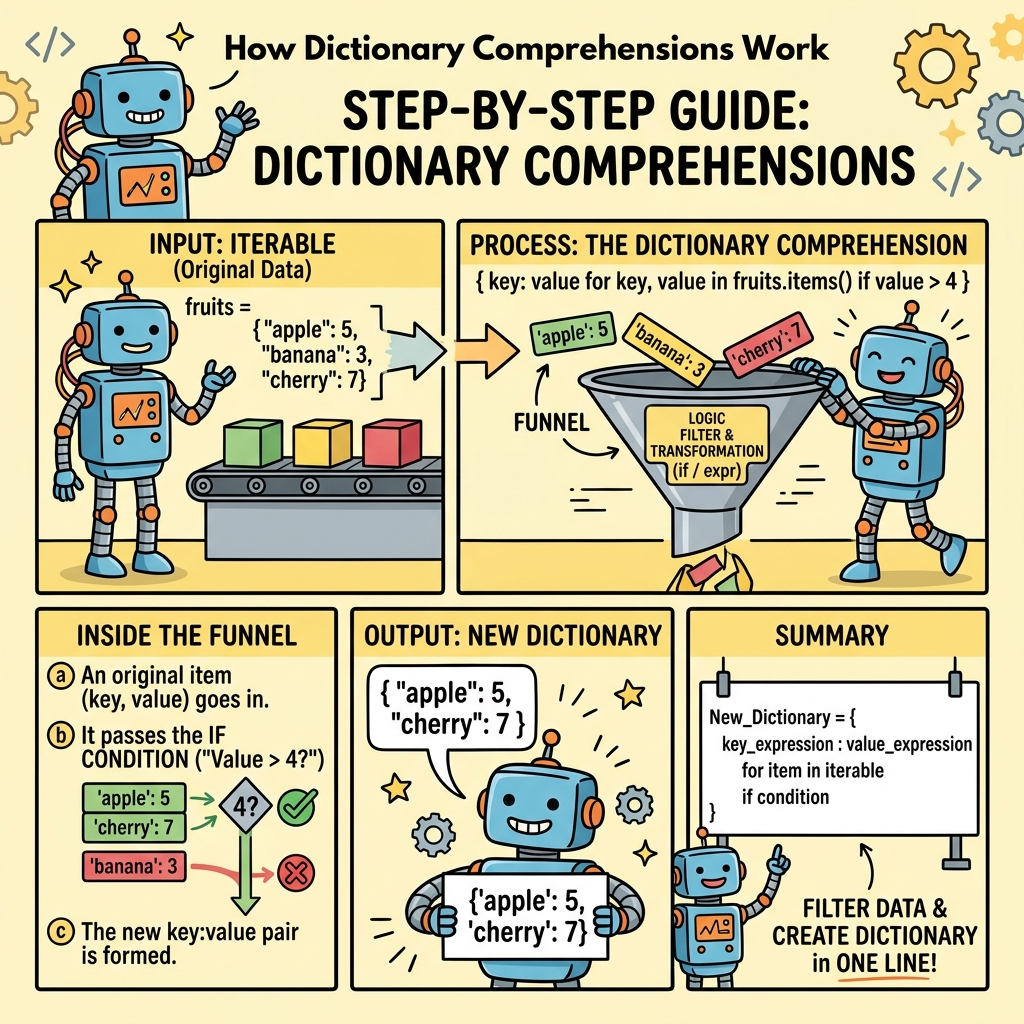
A dictionary comprehension is a syntactic construct that allows you to build dictionaries in a single, compact expression. The general syntax looks like this:
📌 Deep Dive: Dictionary Comprehension Syntax
{key_expression: value_expression for item in iterable if condition}Breaking this down:
key_expression: An expression to compute the dictionary's key for each item.value_expression: An expression to compute the corresponding value.for item in iterable: Looping over an iterable source of data.if condition(optional): A filter to include only items for which the condition isTrue.
This lets you generate dictionaries by transforming and filtering data in a single readable line instead of writing longer loops.
Why Use Dictionary Comprehensions?
Before comprehensions, you might build dictionaries using a traditional loop:
📌 Deep Dive: Traditional Dictionary Construction
squares = {}
for x in range(5):
    squares[x] = x**2
print(squares)With dictionary comprehensions, this becomes:
📌 Deep Dive: Dictionary Comprehension Alternative
squares = {x: x**2 for x in range(5)}
print(squares)This version is not only shorter, but easier to read and understand at a glance. Using dictionary comprehensions improves clarity and reduces boilerplate code.
Building Dictionary Comprehensions Step-by-Step
Let's walk through how to construct dictionary comprehensions with practical examples.
1. Basic Dictionary Creation
Suppose you want to create a dictionary mapping numbers to their cubes:
📌 Deep Dive: Cubes Dictionary
cubes = {num: num**3 for num in range(6)}
print(cubes)Here, for each number num from 0 to 5, the key is num itself and the value is its cube num**3.
2. Adding Conditional Logic
You can add an if clause to filter items. For example, create a dictionary of squares only for even numbers:
📌 Deep Dive: Filtered Dictionary Comprehension
even_squares = {x: x**2 for x in range(10) if x % 2 == 0}
print(even_squares)This filters out odd numbers, producing a dictionary only of even number squares.
3. Transforming Existing Data Structures
Dictionary comprehensions are very useful for transforming data. Imagine you have a list of fruits and want to create a dictionary mapping each fruit's name to its length:
📌 Deep Dive: From List to Dictionary
fruits = ['apple', 'banana', 'cherry', 'date']
lengths = {fruit: len(fruit) for fruit in fruits}
print(lengths)You can also apply conditions, such as including only fruits with names longer than 5 letters:
📌 Deep Dive: Conditional Value Filtering
long_fruits = {fruit: len(fruit) for fruit in fruits if len(fruit) > 5}
print(long_fruits)Comparing Dictionary Comprehensions with Other Methods
Dictionary comprehensions provide a more readable and concise alternative to using loops or the dict() constructor combined with zip() or map(). Here's a quick comparison:
| Method | Example |
|---|---|
| For Loop | result = {} |
| Dictionary Comprehension | {x: x+1 for x in range(3)} |
| Using dict + zip | dict(zip(range(3), [x+1 for x in range(3)])) |
Among these, dictionary comprehensions are often the clearest and most pythonic choice, especially for transformations and filtering.
Advanced Example: Nested Loops in Dictionary Comprehensions
Just like list comprehensions, dictionary comprehensions can include nested loops to create more complex dictionaries. For example, let's create a dictionary mapping coordinate tuples to their Manhattan distance from the origin:
📌 Deep Dive: Nested Loops in Dictionary Comprehensions
coords = {(x, y): abs(x) + abs(y) for x in range(-1, 2) for y in range(-1, 2)}
print(coords)This dictionary comprehension runs two nested loops over x and y, creating keys as coordinate tuples and values as their Manhattan distances.
💡 Tip
Use nested loops in dictionary comprehensions to map multi-dimensional data or create lookup tables efficiently.
Common Pitfalls and How to Avoid Them
⚠️ Key Uniqueness
Remember that dictionary keys must be unique. If your comprehension generates duplicate keys, later values will overwrite earlier ones without warning.
⚠️ Mutable Keys
Avoid using mutable types like lists or dictionaries as keys since keys must be hashable and immutable. Use tuples or strings instead.
For example, this will cause an error:
📌 Deep Dive: Immutable Keys Required
# This will raise a TypeError
keys = [[1, 2], [3, 4]]
d = {k: sum(k) for k in keys}
Because lists are unhashable, they cannot be dictionary keys.
Real-World Use Case: Counting Word Frequencies
Dictionary comprehensions can also help summarize data quickly. Suppose you want to count the frequency of each word in a list:
📌 Deep Dive: Word Frequency Dictionary
words = ['apple', 'banana', 'apple', 'cherry', 'banana', 'banana']
freq = {word: words.count(word) for word in set(words)}
print(freq)By converting the list to a set first, we avoid redundant counts, producing a neat dictionary of word frequencies.
Summary: When to Use Dictionary Comprehensions
- Generating dictionaries from sequences or iterables with transformed keys and values.
- Filtering data while building dictionaries in a single expression.
- Transforming existing dictionaries or lists into new dictionaries.
- Creating lookup tables or mappings efficiently, including nested loops for multidimensional data.
Dictionary comprehensions are a powerful tool in your Python toolkit, making your code more elegant, faster to write, and easier to read. Practice using them to build fluency and unlock more expressive solutions!
Quick Knowledge Check
Test what you just learned
Question 1 of 2
Which of the following is the correct syntax for a dictionary comprehension that squares numbers from 0 to 4?
Question 2 of 2
What will happen if a dictionary comprehension generates duplicate keys?
Loading results...