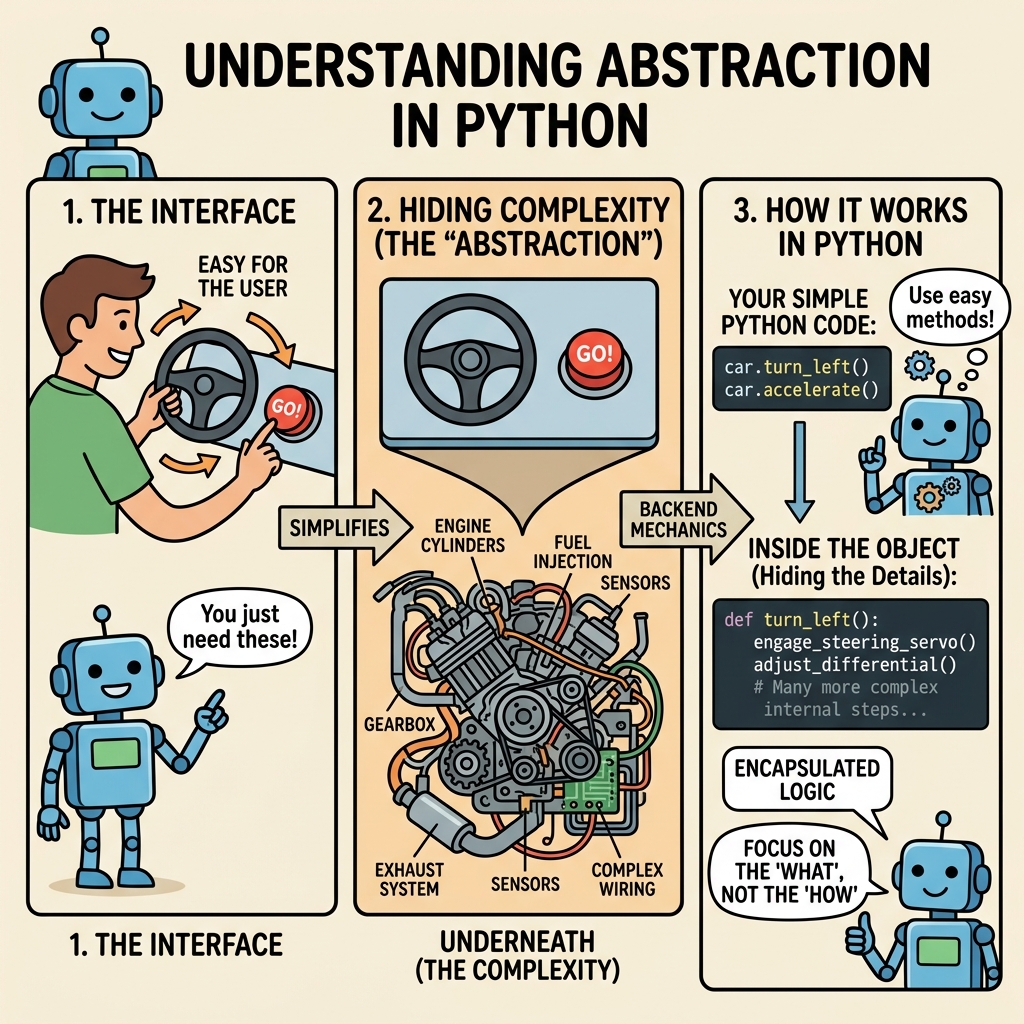
When diving into programming, you often encounter complex systems with numerous details. Managing all these intricacies at once would be overwhelming and inefficient. This is where abstraction comes into play — a fundamental concept that helps simplify complexity by hiding the unnecessary details from the user and exposing only the essential features.
In Python, abstraction allows developers to focus on what an object does instead of how it accomplishes it. It’s a cornerstone of object-oriented programming and a powerful tool to create clean, modular, and maintainable code.
What Is Abstraction?
Abstraction is the process of exposing only relevant attributes and behaviors of an object while hiding the internal implementation details. By doing so, it provides a clear and simplified interface for the user to interact with the object without worrying about the complexities behind the scenes.
💡 Abstraction in Everyday Life
Think about driving a car. You interact with the steering wheel, accelerator, and brakes, but you don’t need to understand how the engine works internally. The car abstracts away the complex mechanics, so you can focus on driving safely.
Why Is Abstraction Important in Programming?
Abstraction plays several crucial roles in programming:
- Reduces complexity: By hiding unnecessary details, programs become easier to understand and maintain.
- Improves code reusability: Abstract interfaces allow different implementations without changing how clients interact with them.
- Enhances security: Sensitive data and internal workings can be hidden from the outside world.
- Supports modular design: Systems can be broken down into smaller components with well-defined interfaces.
How Is Abstraction Achieved in Python?
Python provides several mechanisms to implement abstraction, primarily through abstract base classes and interfaces. The abc module in Python’s standard library is used to create abstract classes and methods.
An abstract class is a class that cannot be instantiated on its own and serves as a blueprint for other classes. It may contain abstract methods — methods declared but without implementation — that derived classes are required to override.
Understanding Abstract Base Classes (ABCs)
Let’s explore how to use the abc module to define abstract classes and methods.
📌 Deep Dive: Creating an Abstract Class
from abc import ABC, abstractmethod

class Vehicle(ABC):
    @abstractmethod
    def start_engine(self):
        pass

    @abstractmethod
    def stop_engine(self):
        pass

# Trying to instantiate Vehicle will raise an error:
# v = Vehicle()  # TypeError: Can't instantiate abstract class Vehicle with abstract methods start_engine, stop_engine
Here, Vehicle is an abstract class with two abstract methods: start_engine and stop_engine. Any subclass must provide concrete implementations for these methods.
Implementing Concrete Subclasses
Now, let’s create subclasses that inherit from Vehicle and implement the abstract methods.
📌 Deep Dive: Concrete Implementations of Abstract Methods
class Car(Vehicle):
    def start_engine(self):
        print("Car engine started.")

    def stop_engine(self):
        print("Car engine stopped.")

class Motorcycle(Vehicle):
    def start_engine(self):
        print("Motorcycle engine started.")

    def stop_engine(self):
        print("Motorcycle engine stopped.")

car = Car()
car.start_engine()          # Output: Car engine started.
car.stop_engine()           # Output: Car engine stopped.

motorcycle = Motorcycle()
motorcycle.start_engine()   # Output: Motorcycle engine started.
motorcycle.stop_engine()    # Output: Motorcycle engine stopped.
Car engine stopped.
Motorcycle engine started.
Motorcycle engine stopped.
By enforcing this contract via abstraction, we ensure that all subclasses of Vehicle provide the required behavior, while hiding the internal specifics of how each vehicle starts or stops its engine.
Abstract Classes vs Concrete Classes: A Quick Summary
| Aspect | Abstract Class | Concrete Class |
|---|---|---|
| Instantiation | Cannot be instantiated directly | Can be instantiated |
| Purpose | Defines interface and contract | Provides concrete implementation |
| Methods | Contains abstract methods (no implementation) | Implements all methods |
| Inheritance | Meant to be subclassed | May or may not be subclassed |
Encapsulation vs Abstraction: Understanding the Difference
While abstraction hides complexity, encapsulation hides the internal state of an object and protects it from unintended interference. Both concepts are related but serve different purposes.
💡 Key Distinction
Encapsulation is about restricting direct access to some of an object’s components (e.g., using private variables). Abstraction is about exposing only the necessary features of an object and hiding the rest.
Using Abstraction with Properties and Methods
Abstraction can also be applied by defining interfaces with methods and properties that hide internal data representation. Python’s @property decorator is a common tool to provide an abstracted view of data.
📌 Deep Dive: Abstracting Data Access via Properties
class TemperatureSensor:
    def __init__(self, temp_celsius):
        self._temp_celsius = temp_celsius  # Internal data hidden

    @property
    def temp_fahrenheit(self):
        # Abstracted property, converts Celsius to Fahrenheit
        return (self._temp_celsius * 9/5) + 32

sensor = TemperatureSensor(25)
print(sensor.temp_fahrenheit)  # Output: 77.0
Users of TemperatureSensor don’t need to know how the temperature is stored or converted. They simply access temp_fahrenheit as a property, which abstracts away the conversion logic.
Practical Example: Designing a Payment System with Abstraction
Imagine building a payment processing system that supports multiple payment methods like credit cards and PayPal. Each payment method implements a common interface, but the internal workings differ.
📌 Deep Dive: Payment Processor Abstraction
from abc import ABC, abstractmethod

class PaymentProcessor(ABC):
    @abstractmethod
    def pay(self, amount):
        pass

class CreditCardProcessor(PaymentProcessor):
    def pay(self, amount):
        print(f"Processing credit card payment of ${amount}")

class PayPalProcessor(PaymentProcessor):
    def pay(self, amount):
        print(f"Processing PayPal payment of ${amount}")

def process_payment(processor: PaymentProcessor, amount):
    processor.pay(amount)

cc_processor = CreditCardProcessor()
paypal_processor = PayPalProcessor()

process_payment(cc_processor, 100)      # Processing credit card payment of $100
process_payment(paypal_processor, 200)  # Processing PayPal payment of $200
Processing PayPal payment of $200
Here, the PaymentProcessor abstract base class defines the interface. Different processors implement the pay method as per their specific logic. The payment system code can work with any processor type without changing its own structure, thanks to abstraction.
Best Practices for Using Abstraction in Python
- Define clear interfaces: Use abstract base classes to specify what methods subclasses must implement.
- Hide implementation details: Keep internal methods and attributes private or protected using naming conventions (single or double underscores).
- Use properties: Abstract data representation with
@propertyto provide controlled access. - Favor composition over inheritance: Use abstraction to define flexible interfaces that can be implemented by multiple classes.
- Document abstract classes: Clearly explain the purpose and expected behavior of abstract methods.
⚠️ Avoid Over-Abstraction
While abstraction is powerful, too much abstraction can lead to unnecessary complexity and make your code harder to follow. Strive for balance and abstract only what is needed to simplify your design.
Summary
Abstraction is a key concept that helps you manage complexity by focusing on essential features while hiding implementation details. In Python, it is primarily implemented using abstract base classes from the abc module. By using abstraction, you can create flexible, modular, and maintainable code that clearly defines interfaces and enforces contracts between components.
Remember, abstraction is not just about writing abstract classes; it is a mindset to design systems that separate what something does from how it does it.
Quick Knowledge Check
Test what you just learned
Question 1 of 2
What is the main purpose of abstraction in Python programming?
Question 2 of 2
Which Python module is commonly used to create abstract base classes?
Loading results...