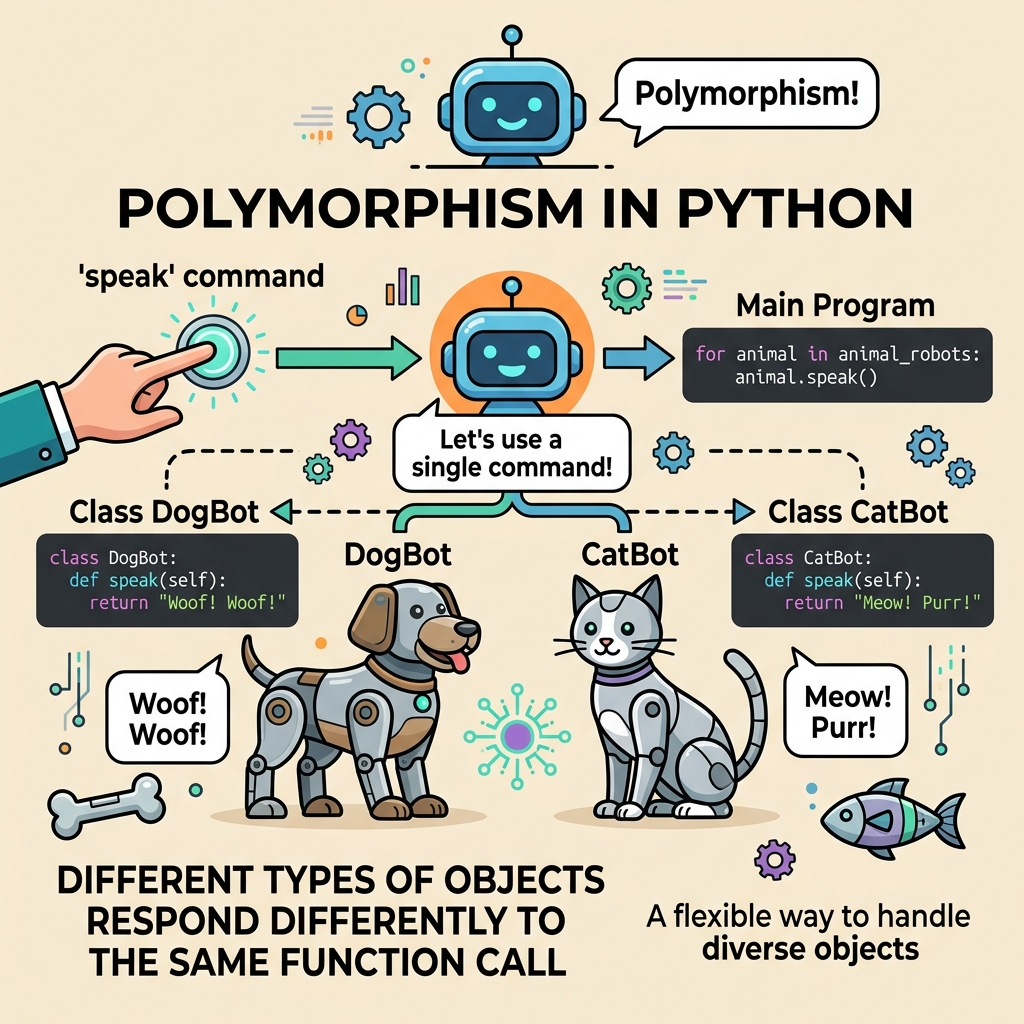
Welcome to the fascinating world of Polymorphism in Python! As a fundamental concept in object-oriented programming (OOP), polymorphism allows objects of different classes to be treated through a common interface, enabling flexible and reusable code. By the end of this lesson, you’ll understand what polymorphism is, why it matters, and how to use it effectively in your Python projects.
Imagine you have various types of payment methods—credit card, PayPal, or cryptocurrency—but you want your program to process payments without worrying about the specific method. Polymorphism lets you write code that can handle all these different payment types uniformly while allowing each method to behave differently under the hood.
💡 Key Idea
Polymorphism means "many forms". It allows the same interface to represent different underlying forms (data types or classes).
What is Polymorphism in Python?
Polymorphism is a principle in OOP where objects of different classes can be accessed through the same interface, typically via methods with the same name but potentially different implementations. It allows functions or methods to use objects of different types at different times without modification.
In Python, polymorphism mainly manifests in two ways:
Method Overriding: Subclasses provide a specific implementation of a method already defined in a superclass.
Duck Typing: Python’s dynamic typing system allows any object that implements the required methods or behaviors to be used, regardless of its actual type.
Both forms empower your code to be more flexible, maintainable, and extensible.
Why is Polymorphism Important?
Consider a scenario where you are building a drawing application. You could have many shapes such as circles, rectangles, and triangles. Each shape has a draw() method, but the drawing implementation varies by shape. Polymorphism lets you call draw() on any shape object without needing to check its specific type.
Without polymorphism, you might have to write conditional statements to handle each shape type separately, resulting in verbose and hard-to-maintain code.
💡 Real World Analogy
Think of a universal remote control that works with multiple devices — TV, DVD player, or sound system. The remote interface is the same, but the commands it sends vary depending on the device.
How Polymorphism Works in Python
Let’s explore the core mechanisms that enable polymorphism in Python.
1. Method Overriding
When a subclass provides its own implementation of a method that is already defined in its superclass, it’s called method overriding. This allows each subclass to behave differently while sharing the same method name.
📌 Deep Dive: Method Overriding
PYTHON
class Animal:
    def speak(self):
        print("Animal makes a sound")

class Dog(Animal):
    def speak(self):
        print("Dog barks")

class Cat(Animal):
    def speak(self):
        print("Cat meows")

# Using the classes
animal = Animal()
dog = Dog()
cat = Cat()

animal.speak()  # Animal makes a sound
dog.speak()     # Dog barks
cat.speak()     # Cat meows
Output
Animal makes a sound Dog barks Cat meows
Notice how each subclass redefines speak(), enabling different behavior while sharing the same interface.
2. Polymorphic Functions
Functions that work with polymorphic objects don’t need to know the exact class of the object, only that it has the required methods. This is a cornerstone of flexible programming.
📌 Deep Dive: Polymorphic Function
PYTHON
def animal_sound(animal):
    animal.speak()

dog = Dog()
cat = Cat()

animal_sound(dog)  # Dog barks
animal_sound(cat)  # Cat meows
Output
Dog barks Cat meows
This function doesn’t care about the specific type of animal; it just calls speak(), trusting the object to respond correctly.
3. Duck Typing
Python supports polymorphism without requiring inheritance or explicit interfaces. If an object has the needed methods or attributes, it can be used in that context. This philosophy is summed up as:
"If it looks like a duck, swims like a duck, and quacks like a duck, then it probably is a duck."
📌 Deep Dive: Duck Typing Example
PYTHON
class Duck:
    def quack(self):
        print("Quack, quack!")

class Person:
    def quack(self):
        print("I'm imitating a duck!")

def make_it_quack(thing):
    thing.quack()

duck = Duck()
person = Person()

make_it_quack(duck)    # Quack, quack!
make_it_quack(person)  # I'm imitating a duck!
Output
Quack, quack! I'm imitating a duck!
Neither Duck nor Person inherits from a common superclass, but both can be passed to make_it_quack() because they implement a quack() method.
Architecture of Polymorphism
Polymorphism vs Inheritance vs Encapsulation
Polymorphism is often discussed alongside other OOP principles. Here’s a quick comparison to clarify their distinct roles:
OOP Concepts Comparison
Concept
Description
Inheritance
Enables a class to derive properties and behaviors from a parent class.
Encapsulation
Bundles data and methods inside a class, restricting direct access to some components.
Polymorphism
Allows objects of different classes to be treated as objects of a common superclass, especially via overridden methods.
Implementing Polymorphism in Real-World Python Code
Let’s build a mini example mimicking an online store with different payment methods.
📌 Deep Dive: Payment Processing with Polymorphism
PYTHON
class PaymentMethod:
def pay(self, amount):
raise NotImplementedError("Subclasses must implement this")
class CreditCard(PaymentMethod):
def pay(self, amount):
print(f"Paying ${amount} using Credit Card")
class PayPal(PaymentMethod):
def pay(self, amount):
print(f"Paying ${amount} using PayPal")
class Crypto(PaymentMethod):
def pay(self, amount):
print(f"Paying ${amount} using Cryptocurrency")
def process_payment(payment_method, amount):
payment_method.pay(amount)
cc = CreditCard()
paypal = PayPal()
crypto = Crypto()
process_payment(cc, 100) # Paying $100 using Credit Card
process_payment(paypal, 150) # Paying $150 using PayPal
process_payment(crypto, 200) # Paying $200 using Cryptocurrency
Output
Paying $100 using Credit Card Paying $150 using PayPal Paying $200 using Cryptocurrency
This example highlights:
A base class PaymentMethod defines the interface pay().
Subclasses implement the specific payment processing logic.
The function process_payment() uses polymorphism to process any payment method without modification.
Common Pitfalls When Using Polymorphism
Assuming methods always exist: With duck typing, if an object lacks the required method, your code will raise an error at runtime. It’s good practice to check or catch exceptions.
Overusing inheritance: Polymorphism is often tied to inheritance, but deep inheritance hierarchies can be complex and fragile. Favor composition and duck typing when possible.
Ignoring readability: While polymorphism enables flexible code, overusing it or hiding too much behavior can make code harder to understand and debug.
⚠️ Tip for Beginners
Start by practicing method overriding in simple inheritance hierarchies. Then experiment with duck typing to see how Python’s dynamic nature supports polymorphism without strict class hierarchies.
Summary: The Power of Polymorphism
Polymorphism is a vital tool in any Python programmer’s toolkit. It lets you write code that is:
Extensible: Add new object types without changing existing code.
Maintainable: Reduce complex conditional logic.
Flexible: Treat different objects uniformly while preserving individual behaviors.
By mastering polymorphism, you’ll improve your ability to design clean, scalable, and professional Python applications.
💡
Quick Knowledge Check
Test what you just learned
Question 1 of 2
What does polymorphism enable in Python?
Question 2 of 2
Which of the following is an example of duck typing?