When you dive into object-oriented programming with Python, you quickly learn about instance methods — the functions that operate on individual objects, or instances, of a class. But Python offers more than just instance methods. Two powerful, yet often misunderstood, method types are class methods and static methods. These methods open up new ways to organize and structure your code, making it more flexible, readable, and aligned with real-world scenarios.
In this comprehensive lesson, we'll explore what class and static methods are, why and when to use them, how they differ from instance methods, and practical examples to solidify your understanding.
Understanding the Basics: Instance Methods Recap
Before we dig into class and static methods, it’s helpful to recall what instance methods are. Instance methods are the typical methods you define in a class that operate on a specific object, or instance. They automatically receive the instance as their first argument, conventionally named self.
📌 Deep Dive: Instance Method Example
class Dog:
    def __init__(self, name):
        self.name = name

    def speak(self):
        return f"{self.name} says Woof!"

dog = Dog("Buddy")
print(dog.speak())  # Buddy says Woof!
Here, speak is an instance method, because it uses self to access the specific dog’s name.
What Are Class Methods?
Class methods are methods that operate on the class itself, rather than on individual instances. Instead of receiving the instance as the first argument, they receive the class as the first argument, which is conventionally named cls. This means class methods can access and modify class state that applies across all instances.
To define a class method, you use the @classmethod decorator.
💡 Why Use Class Methods?
Class methods are great when you want a method tied to the class, not an instance. For example, they’re commonly used for alternative constructors or methods that affect the class state.
Class Method Syntax & Example
📌 Deep Dive: Defining and Using a Class Method
class Pizza:
    base_price = 10  # class variable for all pizzas

    def __init__(self, toppings):
        self.toppings = toppings

    def price(self):
        # Price depends on toppings count + base price
        return Pizza.base_price + 2 * len(self.toppings)

    @classmethod
    def set_base_price(cls, price):
        cls.base_price = price

# Change the base price for all pizzas
Pizza.set_base_price(12)

p = Pizza(['cheese', 'pepperoni'])
print(p.price())  # 12 + 2*2 = 16
In this example, set_base_price is a class method that modifies the class variable base_price shared by all instances. Notice how it uses cls to reference the class, not an instance.
Static Methods: The Utility Helpers Within Classes
Static methods are somewhat different. They behave like regular functions but live inside the class’s namespace. They do not receive an automatic first argument, neither self nor cls. This means static methods neither modify object state nor class state. Instead, they are logically related to the class and can be called on the class or instances.
To define a static method, you use the @staticmethod decorator.
💡 When to Use Static Methods?
Use static methods for utility functions that have a connection to the class but don’t need to access or modify class or instance data.
Static Method Syntax & Example
📌 Deep Dive: Defining and Using a Static Method
class MathHelper:
    @staticmethod
    def add(x, y):
        return x + y

    @staticmethod
    def multiply(x, y):
        return x * y

print(MathHelper.add(5, 7))        # 12
print(MathHelper.multiply(3, 4))   # 12

# Can also call on an instance (though not common)
helper = MathHelper()
print(helper.add(10, 20))          # 30
12
30
Static methods act like plain functions but grouped inside the class for semantic clarity and organization.
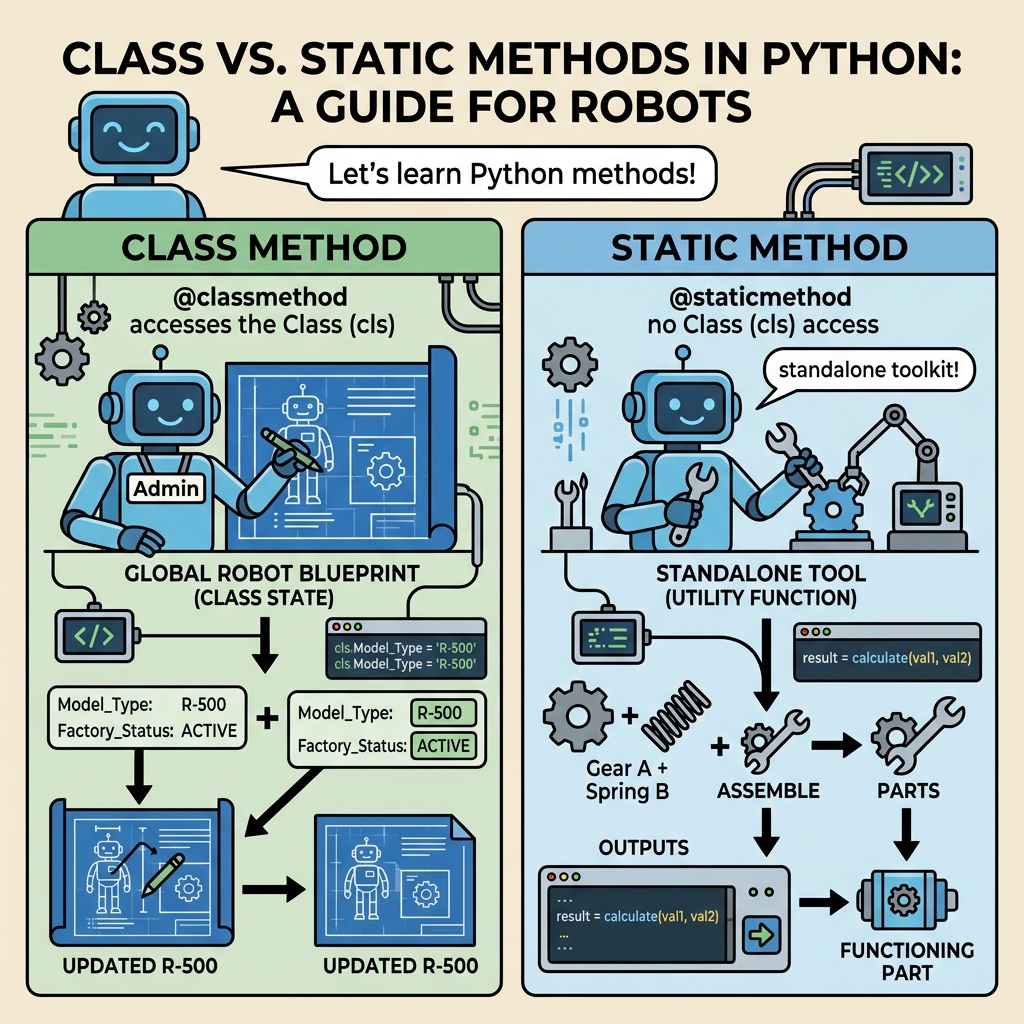
Comparing Instance, Class, and Static Methods
Understanding the differences is crucial for writing clean, maintainable code. Let’s summarize the key distinctions:
| Method Type | First Argument | Accesses | Typical Use Case |
|---|---|---|---|
| Instance Method | self (instance) | Instance attributes and methods | Operations that require instance data |
| Class Method | cls (class) | Class attributes and other class methods | Alternative constructors, modifying class state |
| Static Method | No automatic argument | None (no access to class or instance) | Utility functions tied to the class conceptually |
Practical Example: A Real-World Use Case
Let’s build a simple Employee class that demonstrates instance, class, and static methods working together.
📌 Deep Dive: Employee Class with All Method Types
class Employee:
    raise_amount = 1.05  # 5% raise for all employees

    def __init__(self, first_name, last_name, salary):
        self.first_name = first_name
        self.last_name = last_name
        self.salary = salary

    def full_name(self):
        return f"{self.first_name} {self.last_name}"

    def apply_raise(self):
        self.salary = int(self.salary * self.raise_amount)

    @classmethod
    def set_raise_amount(cls, amount):
        cls.raise_amount = amount

    @classmethod
    def from_string(cls, emp_str):
        first, last, salary = emp_str.split('-')
        return cls(first, last, int(salary))

    @staticmethod
    def is_workday(day):
        # day is a datetime.date object
        return day.weekday() < 5  # Monday=0, Sunday=6

# Creating employee from string using class method (alternative constructor)
emp1 = Employee.from_string('John-Doe-70000')
print(emp1.full_name())  # John Doe

# Apply raise using instance method
emp1.apply_raise()
print(emp1.salary)  # 73500 (70000 * 1.05)

# Change raise amount for all employees via class method
Employee.set_raise_amount(1.10)

emp2 = Employee('Jane', 'Smith', 80000)
emp2.apply_raise()
print(emp2.salary)  # 88000 (80000 * 1.10)

import datetime
my_date = datetime.date(2024, 6, 12)  # Wednesday
print(Employee.is_workday(my_date))  # True

weekend_date = datetime.date(2024, 6, 15)  # Saturday
print(Employee.is_workday(weekend_date))  # False
73500
88000
True
False
In this example:
- Instance methods like
full_nameandapply_raiseoperate on individual employee objects. - Class methods like
set_raise_amountandfrom_stringmodify class-wide data or provide alternative ways to create instances. - Static method
is_workdaychecks if a given date is a workday — it logically belongs to the Employee class but doesn't need instance or class data.
Common Pitfalls & Best Practices
⚠️ Mixing Up Methods
Remember that instance methods require self, class methods require cls, and static methods take no special first argument. Forgetting these will cause errors or unexpected behavior.
⚠️ Overusing Static Methods
Static methods are useful but avoid overusing them. If a method needs class or instance state, it should not be static. Overusing static methods can lead to poorly organized code.
💡 Pro Tip: Use class methods as alternative constructors to create flexible and expressive APIs for your classes. This pattern is common in many Python libraries.
Summary
Class and static methods are invaluable tools that enhance how your classes behave and interact. Here’s a quick recap:
- Instance methods work with instance data
(self). - Class methods work with class data
(cls)and are great for alternative constructors or class-wide changes. - Static methods don’t access class or instance data but live in the class namespace for organizational clarity.
By mastering these concepts, you’ll write cleaner, more maintainable, and Pythonic object-oriented code.
Quick Knowledge Check
Test what you just learned
Question 1 of 2
Which method type automatically receives the class itself as the first argument?
Question 2 of 2
What is a common use case for static methods in Python classes?
Loading results...